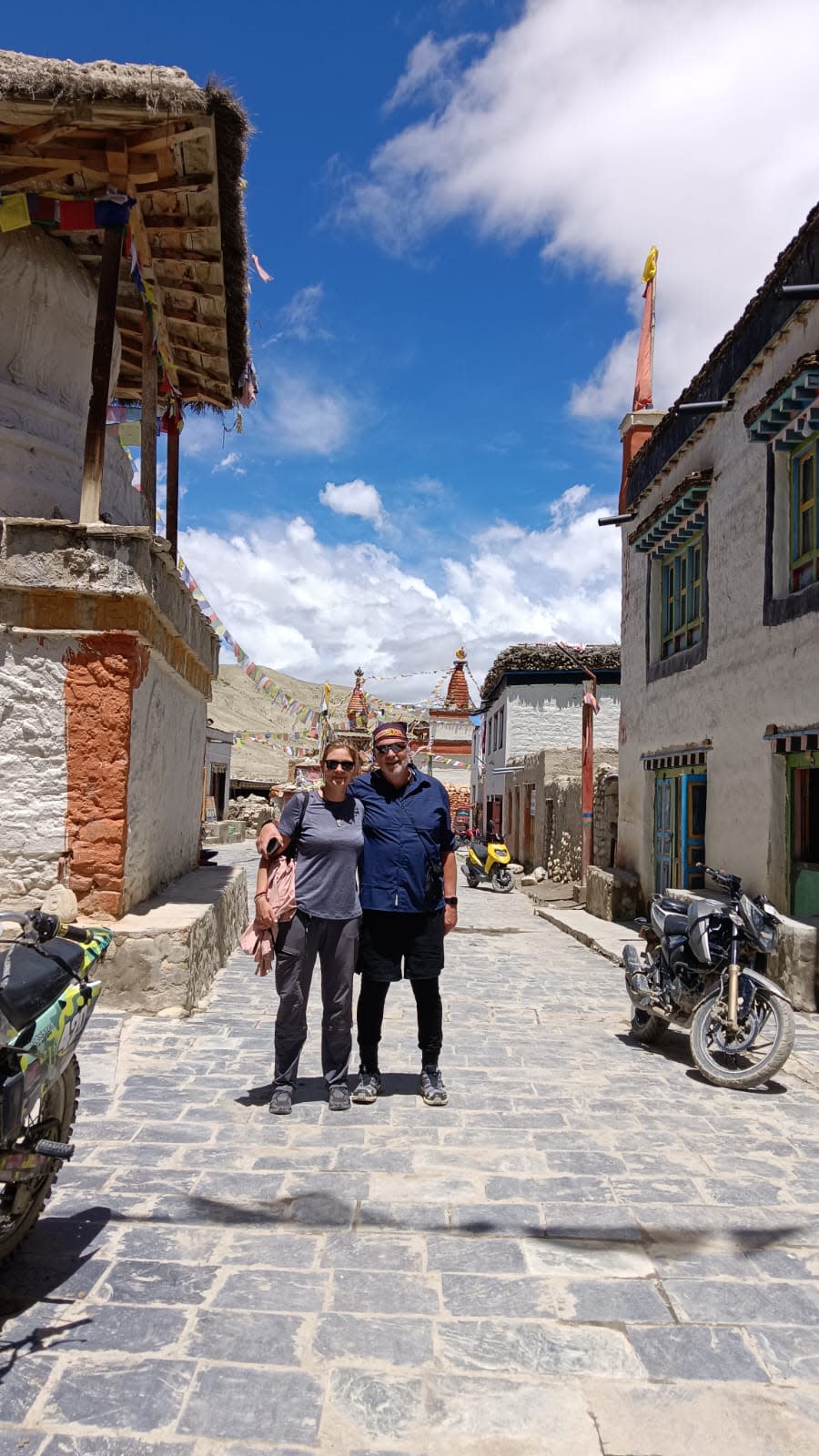
The Upper Mustang Trek is a restricted-area route of 12 to 14 days through the old Kingdom of Lo to Lo Manthang (3,840 metres), the walled capital of Mustang in Nepal's dry north. Since 22 December 2025 the Upper Mustang Restricted Area Permit has cost USD 50 per person per day, replacing the old charge of USD 500 for the first ten days plus USD 50 for each extra one. A second change came on 22 March 2026, when the Department of Immigration dropped the two-person minimum for restricted-area permits nationwide. A solo trekker can now get the permit with a licensed guide and no second paying client. Below are both changes, the day-by-day route, the Tiji festival, the culture of Lo and what the trek costs in 2026.
Mustang stayed closed to foreigners until 1992, and the plateau above Kagbeni still looks more like Tibet than the green hills of the Annapurna region below. Wind-carved cliffs in ochre and grey tower over whitewashed villages, cave dwellings and centuries-old chortens. The region sits in the rain shadow of the Annapurna and Dhaulagiri massifs, which keeps it walkable through the monsoon when most of Nepal's trails are a mess.
Why Upper Mustang needs a restricted-area permit
It has always needed a special permit. The fee funds conservation and local development inside the zone and keeps visitor numbers low, protecting a place that sees a fraction of the Everest or Annapurna Base Camp crowds. Everyone passing the Kagbeni checkpoint into the restricted zone needs one, plus the standard Annapurna Conservation Area Permit (ACAP).

On 22 December 2025 the Department of Immigration replaced the USD 500-for-ten-days fee with USD 50 per person per day. Before, you paid USD 500 up front for the first ten days, then USD 50 for each extra day, whether your trek took eight days or ten. Now you pay for the days you spend inside, so a short loop costs less than the old fee and a long one costs more. Our standard trip spends about 10 to 11 days inside, which puts the permit at roughly USD 500 to 550 per person, about what the old fee came to, but tied to the length of your trip.
ACAP costs NPR 3,000 per person (about USD 23), VAT included. Your agency arranges both permits before you leave, and they're checked at Kagbeni on the way in and again on the way out. For every permit Nepal requires, see our guide to what changed in Mustang's restricted-area permit since December 2025.
You still need a licensed guide from a registered agency, and that hasn't changed. What changed on 22 March 2026 is group size. The two-trekker minimum is gone across Nepal, Upper Mustang included, so you can book the permit alone as long as a licensed guide walks with you. We still run small private departures. Those are a preference now. The permit no longer cares.
Upper Mustang itinerary: Jomsom to Lo Manthang in 12 to 14 days
Most trips start with a 20-minute flight from Pokhara to Jomsom (2,720 metres), then a walk up the Kali Gandaki to Kagbeni (2,810 metres), where the restricted zone begins. From Kagbeni the trail climbs through Chele, Samar and Ghami to Charang and finally Lo Manthang. Our standard itinerary is 14 days door to door. It includes a rest day in Lo Manthang and comes back a different way, past Lo Gekar and the Luri cave monastery.
| Day | Route | Altitude |
|---|---|---|
| 1 | Fly Pokhara to Jomsom, trek to Kagbeni | 2,810m |
| 2 | Kagbeni to Chele (enter restricted zone) | 3,050m |
| 3 | Chele to Samar | 3,660m |
| 4 | Samar to Ghami | 3,520m |
| 5 | Ghami to Charang | 3,560m |
| 6 | Charang to Lo Manthang | 3,840m |
| 7 | Rest day: Lo Manthang monasteries | 3,840m |
| 8 | Lo Manthang to Nyi La to Lo Gekar | 4,010m (Nyi La) |
| 9 | Lo Gekar to Yara via Ghara | 3,650m |
| 10 | Yara to Luri Gompa to Ghami | 3,520m |
| 11 | Ghami to Chele | 3,050m |
| 12 | Chele to Kagbeni to Jomsom | 2,720m |
| 13 | Fly Jomsom to Pokhara | 820m |
| 14 | Pokhara to Kathmandu | 1,400m |
Inside Lo Manthang's walls are roughly 150 to 200 houses, the old royal palace and three working monasteries. Jampa Lhakhang and Thubchen Lhakhang both date from the 15th century, and Chode Gompa still has resident monks. A fourth, Namgyal Gompa, sits on the ridge outside town. Time it right. The rest day lets you see morning light fall through Thubchen's high windows before the afternoon wind gets up.
Beyond Lo Manthang the route crosses Nyi La (about 4,010 metres), the trek's high point. On a clear day you look across the border into the brown sweep of the Tibetan plateau. From there it drops to Lo Gekar and Ghar Gompa, among the oldest monasteries in Mustang, then swings south through Yara to the Luri cave monastery, whose painted chapels date to around the 14th century and see only a few hundred visitors a year.
Jomsom flights leave between 6 and 9 a.m., before the Kali Gandaki's afternoon wind makes the airstrip unsafe, so keep a spare day in Pokhara for weather. Short on time? Cut the loop to 10 or 11 days by walking back the way you came, though you'll miss Luri.
The Tiji festival at Lo Manthang
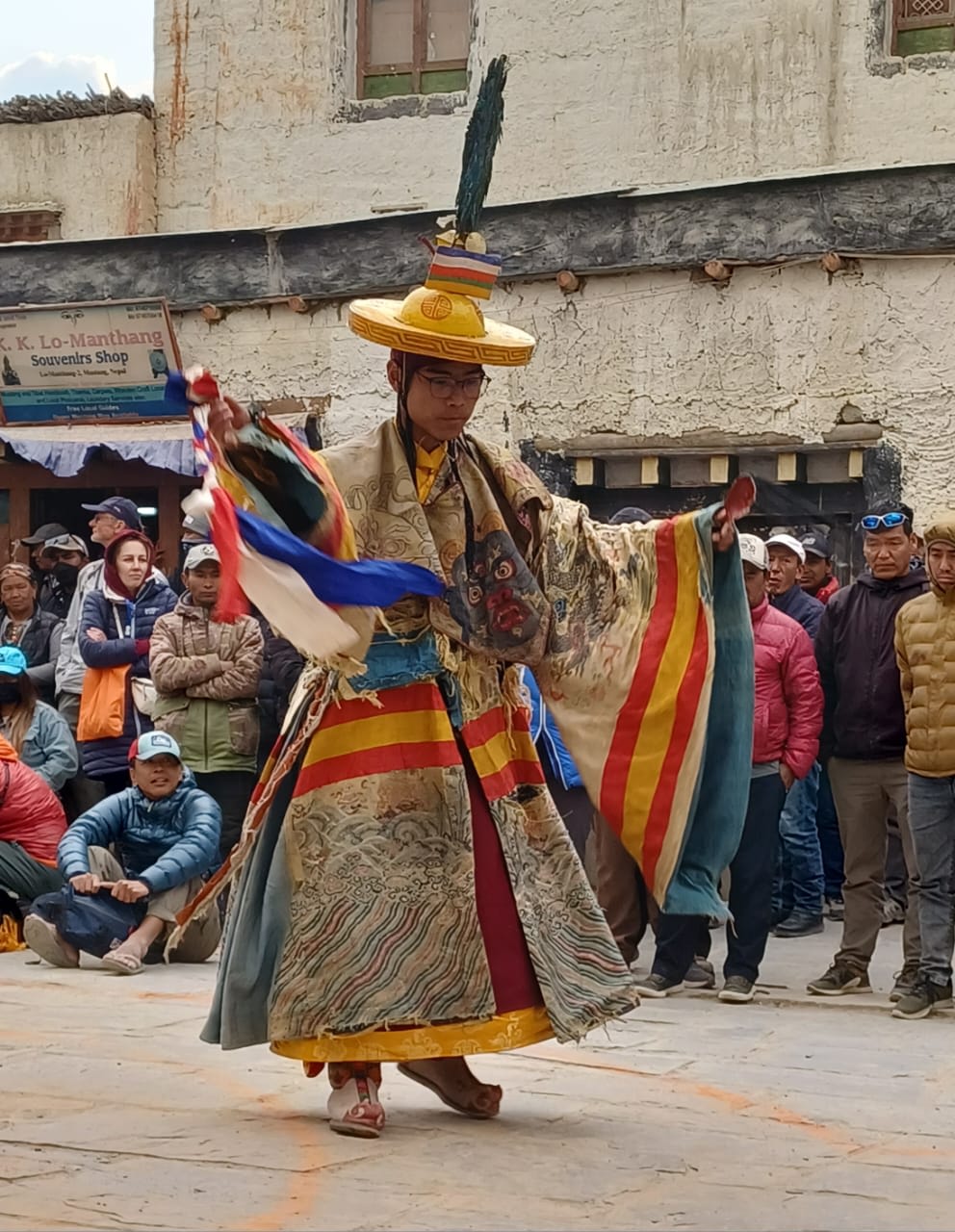
Tiji is a three-day Tibetan Buddhist festival held each spring, usually in May, in Lo Manthang's main square. Monks from Chode Gompa perform masked cham dances that tell how Dorje Jono defeated a demon to save the kingdom. The dates follow the Tibetan lunar calendar and move every year, so ask us for the exact dates well ahead if you want to be there.
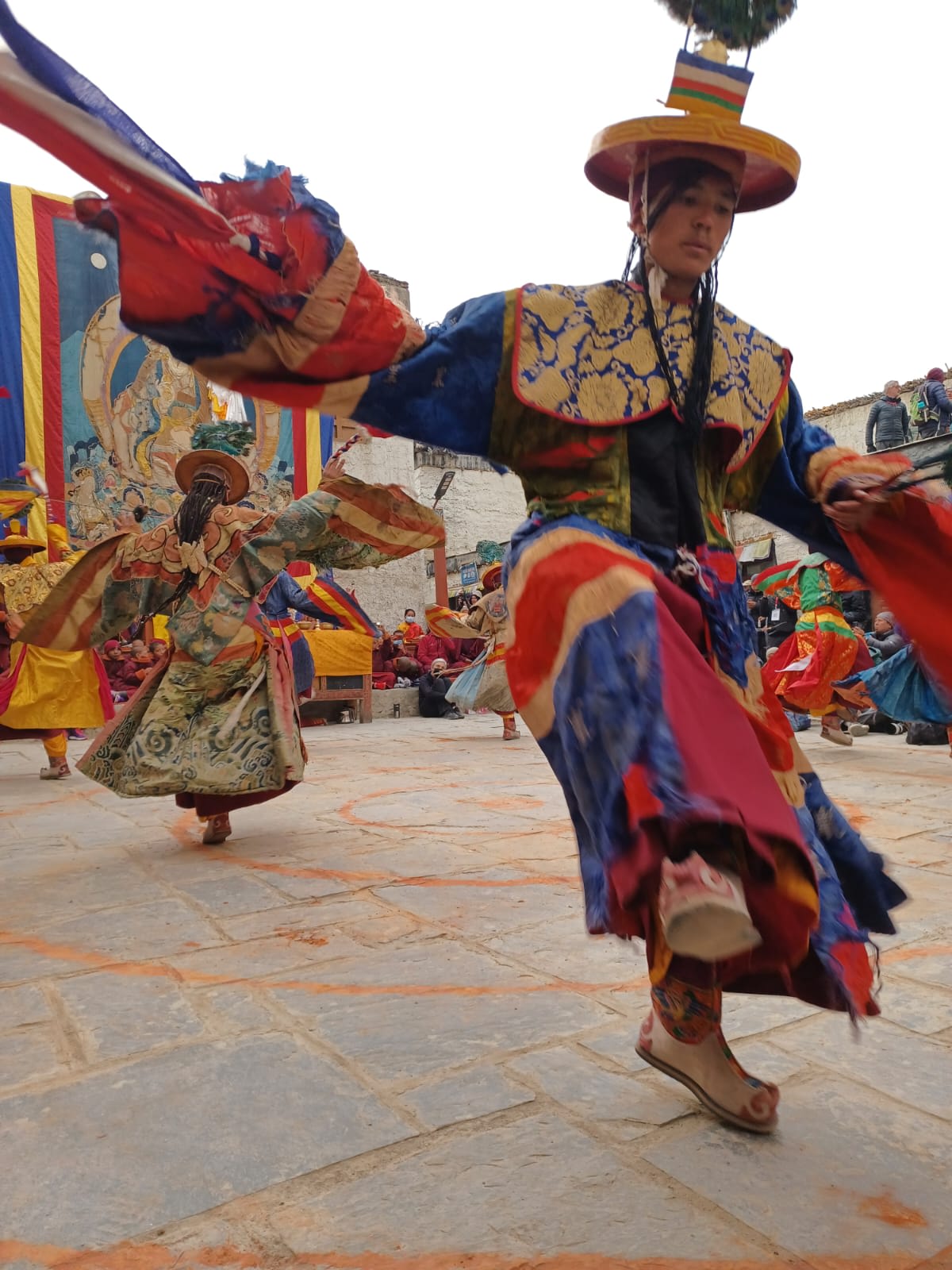
Worth planning around. A trek timed for Tiji gets the best spring weather and the region's biggest cultural event. May departures fill first, often six months out. If your dates miss Tiji, the monasteries, the cave complexes and everyday monastic life still give Mustang a depth of living culture few treks in Nepal can match.
Culture of the kingdom of Lo
The people here are Lobas. They're Tibetan in language and culture, and they practise Tibetan Buddhism with traces of the older Bon religion. Villages like Charang, Ghami and Lo Manthang grew up around their gompas behind mud-brick walls, a legacy of Mustang's place on the salt route between Tibet and the lowlands. Culture shapes this trek far more than altitude does, which sets it apart from the high passes of the Annapurna and Everest regions.
Ghami has one of the longest mani walls in Nepal, several hundred metres of carved prayer stones along the trail into the village. The red cliffs at Drakmar carry a legend about Guru Rinpoche. Life follows the gompa. Its timetable sets the day, with prayers at dawn and dusk and butter tea offered to visitors. Walk clockwise around chortens and mani walls, and ask before taking photos inside monasteries.
Jigme Dorje Palbar Bista, the last Raja of Mustang, kept a recognised ceremonial role until Nepal became a republic in 2008 and died in 2016. His palace still stands in the middle of Lo Manthang. The Yartung horse festival in late summer and Tiji in spring keep the old court culture on show for trekkers who time it right.
Best time to trek: the monsoon rain-shadow window
Upper Mustang gets a small fraction of the rain that falls south of the Annapurna and Dhaulagiri massifs. While the rest of Nepal is soaked from June to August, it stays mostly dry, one of the few treks that runs straight through the monsoon. Spring, March to May, is the other prime season and the only chance to see Tiji.
| Season | Conditions in Upper Mustang |
|---|---|
| Spring (Mar–May) | Warm, dry, clear; Tiji festival in May; busiest |
| Monsoon (Jun–Aug) | Dry rain-shadow trekking while the rest of Nepal is wet |
| Autumn (Sep–Nov) | Clear and stable, cooler nights, very good |
| Winter (Dec–Feb) | Cold and windy; many locals migrate south, services thin out |
Then there's the wind. Most afternoons it gusts at 40 to 60 kilometres an hour, whatever the season, so start early and keep a windproof layer handy. The upper Manang stages of the Circuit share the same dry-belt advantage, as our best time to trek the Annapurna Circuit guide explains.
How much Upper Mustang costs
Our 14-day Upper Mustang Trek starts at USD 1,890 per person, all-inclusive. That covers both permits, a TAAN-certified guide, a porter, teahouse rooms, all trail meals and the Jomsom flights both ways. The permit is still the biggest single item in that price. At USD 50 a day, it now grows or shrinks with the number of days your trip spends inside the zone.
In Lo Manthang a hot shower costs USD 3 to 7, wifi USD 3 to 5 a day and bottled water USD 2 to 4 a litre, all paid to the teahouse on top of the package. Prices above Kagbeni run higher than on the main Annapurna trails, since every kilo of rice, fuel and building material comes in over long, rough roads. Tips come last. Budget around USD 15 to 20 a day for the guide and USD 8 to 12 a day for each porter, shared across the group. The Upper Mustang cost guide has the full budget.
Plan your Upper Mustang Trek
In 2026 Upper Mustang has a permit fee that finally scales with trip length, and one of the last living Tibetan Buddhist kingdoms outside Tibet. We arrange both permits, the Jomsom flights and your licensed guide, alone under the post-March 2026 rules or as a group. As the trekking brand of Swotah Travel and Adventure, founded in 2016 in Budhanilkantha, Kathmandu, we run small, guide-led departures from USD 1,890. See the Upper Mustang Trek page for the full itinerary, or compare a higher-pass option on the Annapurna Circuit. Contact our team for 2026 and 2027 dates, Tiji departures included.
Frequently asked questions
How much is the Upper Mustang permit?
USD 50 per person per day since 22 December 2025, replacing the flat USD 500 for ten days. Our 14-day trip spends about 10 days inside the zone. ACAP adds NPR 3,000.
How many days is the Upper Mustang trek?
Our trip is 14 days door to door, flying between Pokhara and Jomsom and walking to the walled city of Lo Manthang at 3,840 metres. The highest point is Nyi La at about 4,010 metres, so altitude stays moderate.
What is the best time for Upper Mustang?
March to November. Because it sits in the Annapurna rain shadow, it stays mostly dry through the June to August monsoon. May is busiest, thanks to the Tiji festival.
Related guides

Founder & Lead Guide, Annapurna Trekking
AJ founded Annapurna Trekking in 2016 and has personally guided treks across Nepal ever since. More about our team →