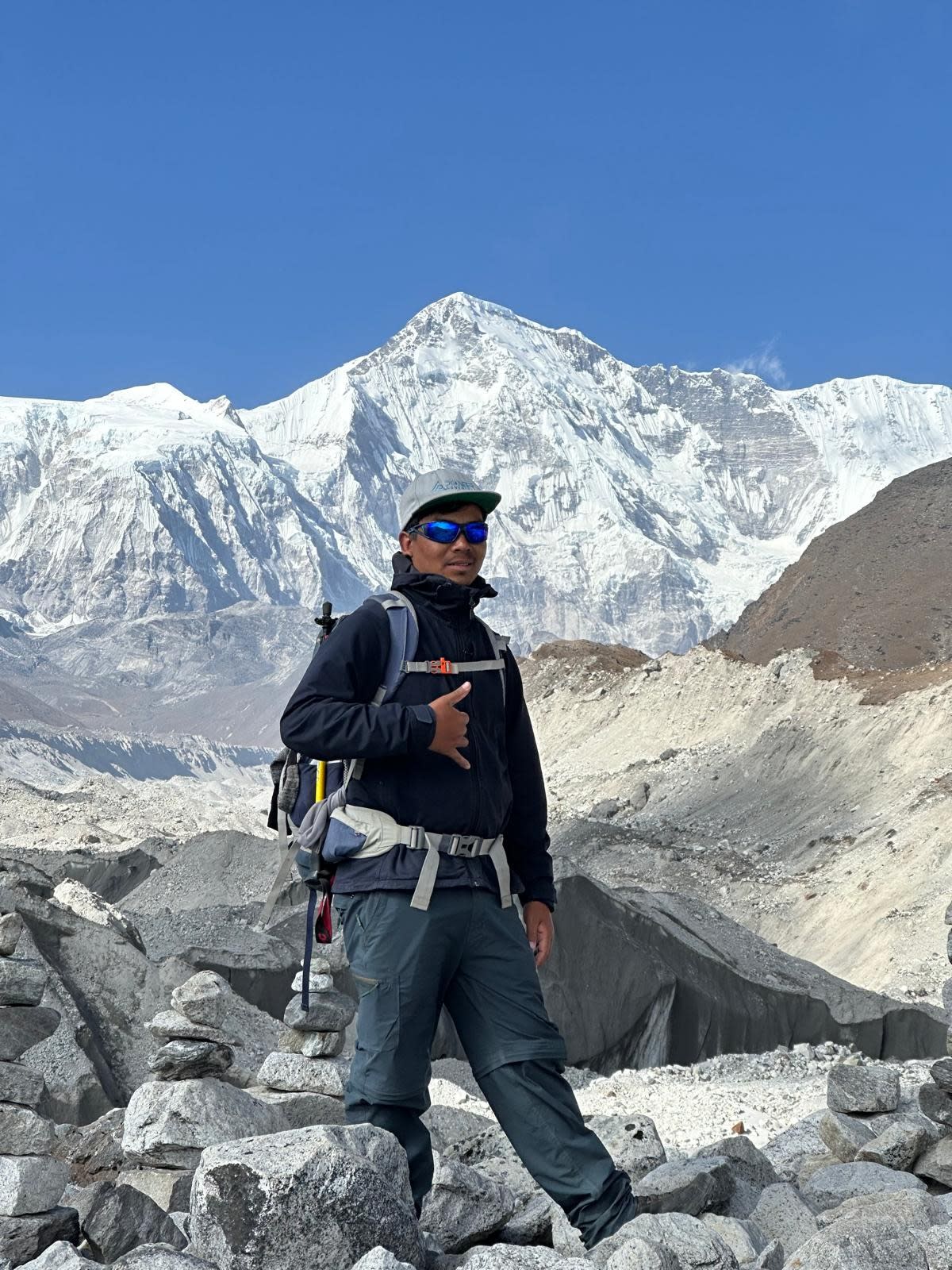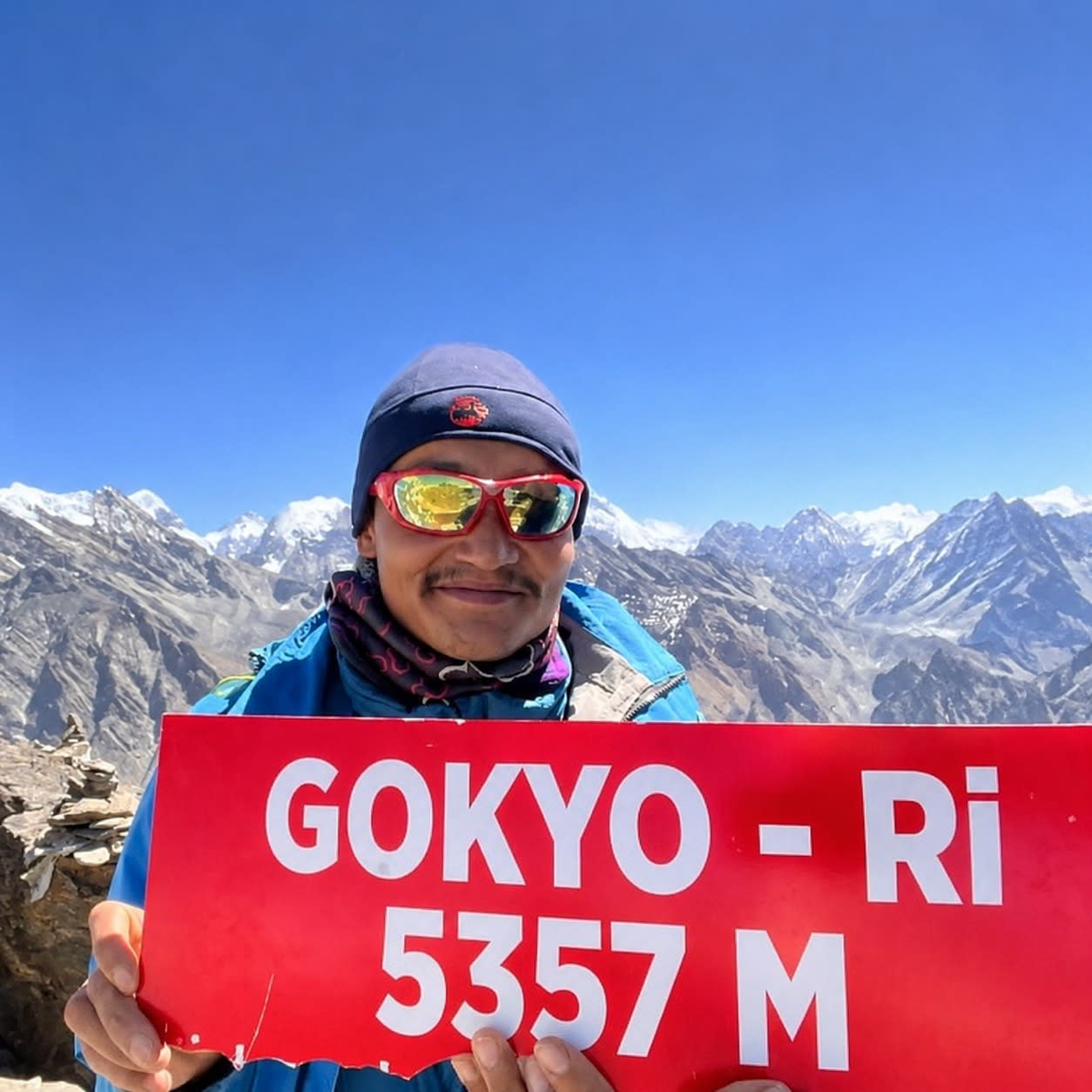

Everest Base Camp Trek
The Everest Base Camp Trek is a 12-to-14-day teahouse expedition from Lukla (2,860 m) to the southern base of Mount Everest (5,364 m) and the Kala Patthar viewpoint (5,545 m). The route opened to foreign trekkers in 1965, twelve years after the first ascent of Everest by Tenzing Norgay and Edmund Hillary on 29 May 1953, and now logs roughly 35,000 to 50,000 completions per year according to Sagarmatha National Park entry records. The trek runs entirely inside Sagarmatha National Park, a 1,148 square kilometre UNESCO World Heritage Site gazetted in 1976 and listed in 1979.
The terrain crosses three distinct ecological zones in fourteen days: subtropical river valley forest below 3,000 m, sub-alpine birch and rhododendron from 3,000 to 4,000 m, and the alpine tundra of the Khumbu glacial moraine above 4,500 m. Cumulative elevation gain is approximately 5,680 m, walked over 130 kilometres of out-and-back trail. You start with a 30-minute mountain flight from Kathmandu to Tenzing-Hillary Airport at Lukla (2,860 m), the gateway to the Khumbu. From Lukla the route follows the Dudh Kosi valley to Phakding (2,610 m), climbs the Namche hill to the Sherpa trading capital of Namche Bazaar (3,440 m), then continues up the valley past Tengboche monastery (3,867 m), through Dingboche (4,410 m), and into the Khumbu glacier moraine at Lobuche (4,910 m). The final push reaches Gorak Shep (5,164 m), with the same-day return walk to base camp on the glacier and a pre-dawn climb of Kala Patthar the following morning for the panoramic Everest view.
Tenzing-Hillary Airport at Lukla is operationally the most weather-sensitive airport on the route; flights are cancelled or diverted to Manthali (a 4-hour drive from Kathmandu) on roughly 20 percent of days in peak season per Tara Air operational records. Our itinerary builds in a contingency buffer for this, plus a mandatory rest-day acclimatisation in Namche Bazaar (day 3) and a second rest day at Dingboche (day 7). High Altitude Cerebral Edema and High Altitude Pulmonary Edema remain the dominant medical risks above 4,500 m. Our guides carry pulse oximeters and an oxygen cylinder, and check blood-oxygen saturation twice daily from Namche onward. The cultural payoff is as significant as the mountain views. The Khumbu valley is the ancestral home of the Sherpa people, a community of Tibetan Buddhist origin who arrived from Salmo Gang in eastern Tibet roughly 500 years ago. Active monasteries at Tengboche (founded 1916), Pangboche (the oldest in Khumbu, dating to 1667), and the small gompa above Dingboche operate daily prayer services that trekkers can attend with respectful conduct. Mani walls, prayer wheels and chortens line the trail in every village from Namche upward.
Upcoming departures.
| Start Date | End Date | Price / Person | Availability | |
|---|---|---|---|---|
| Nov 8, 2026 | Nov 21, 2026 | USD 1,590 | 10 spots left | |
| Mar 22, 2027 | Apr 4, 2027 | USD 1,490 | 12 spots left | |
| Apr 18, 2027 | May 1, 2027 | USD 1,690 | 12 spots left | |
| Jul 19, 2027 | Aug 1, 2027 | USD 1,190 | 12 spots left | |
| Oct 11, 2027 | Oct 24, 2027 | USD 1,690 | 12 spots left |
6 moments you won't forget.
Everest Base Camp at 5,364 metres
The South Side base camp, set on the Khumbu glacier moraine, is the staging point for every Everest summit attempt from April to May.
Kala Patthar at 5,545 metres
A pre-dawn climb above Gorak Shep. The summit gives a direct line of sight to the Everest summit pyramid that base camp itself does not.
Tenzing-Hillary Airport, Lukla
A 527-metre cliff-edge airstrip at 2,846 m. The 30-minute flight from Kathmandu is the trek's first major moment.
Tengboche Monastery at 3,867 metres
The largest gompa in the Khumbu, founded 1916. Daily prayer services open to respectful visitors. Ama Dablam towers behind.
Namche Bazaar, the Sherpa capital
A 600-year-old trading town at 3,440 m built into an amphitheatre. Your acclimatisation rest day stop with bakeries, gear shops and the Sherpa Museum.
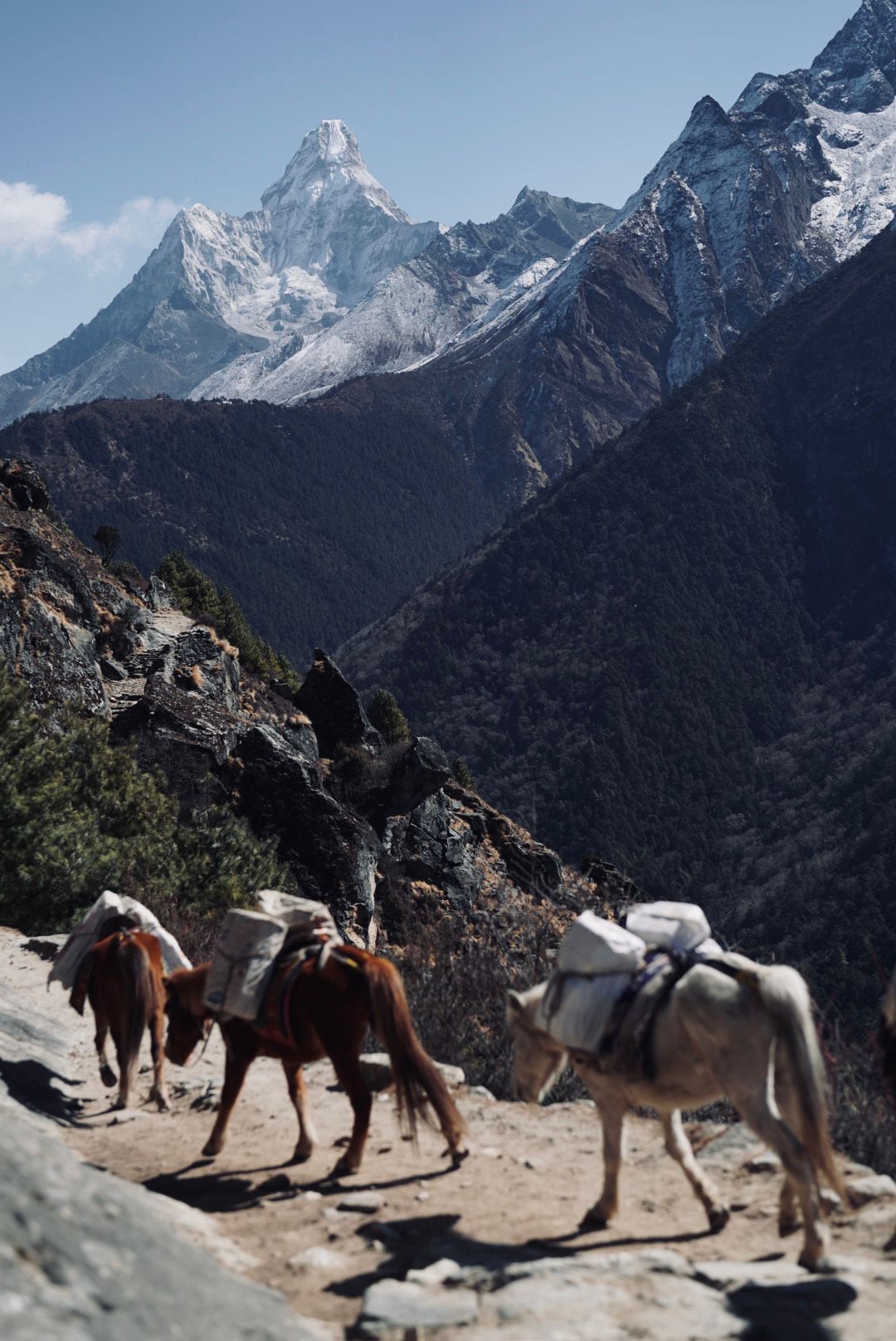
Ama Dablam (6,812 metres)
The most photographed peak in Nepal. Best views from Tengboche, Pangboche and Dingboche on the ascent and return.
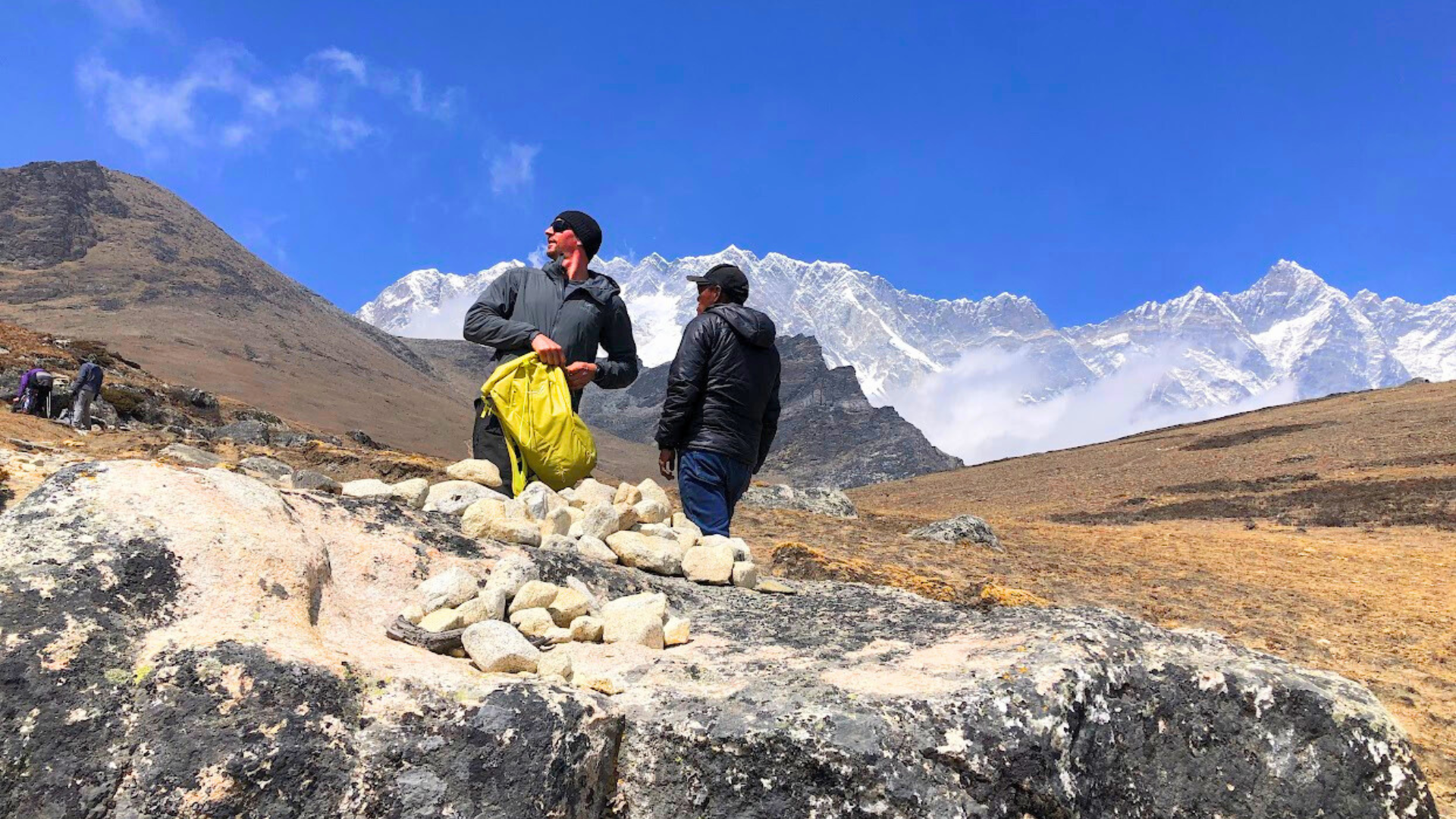
Trek in pictures.


Interactive circuit map.
The full 14-day circuit on a topographic map. Click any marker for details. Switch between Topo, Satellite, and Standard views using the layer control.
14 Days. Every detail planned.
Transparent, all-in pricing.
Included in your price
Not included
Trek altitude at a glance.
How hard is this trek?
Best time for the Everest Base Camp Trek.
Weather on the Everest Base Camp Trek.
Everything you need to know.
Open any card for in-depth notes on accommodation, food, altitude, permits, money and the small print that matters on the trail.
Your safety, planned in detail.
Altitude is the main risk on this trek. Here is exactly what we carry, who we call, and where the nearest help is at every stage of the route.
Common health risks
- •Acute Mountain Sickness (AMS), significant risk above Namche (3,440m)
- •HAPE/HACE: life-threatening, both possible above 4,500m
- •Lukla flight cancellation, weather-dependent, can add 1–3 days
- •Dehydration: accelerated by altitude and dry air
- •Sunburn and snow blindness: UV is 2× stronger at 5,500m
- •Frostbite on Kala Patthar in cold conditions, fingers and toes especially
- •Knee strain on descent days: long downhill from Gorak Shep
- •Stomach upset from unfamiliar food/water, purify everything above Namche
Our medical kit
- •Pulse oximeter (carried by guide, checks oxygen saturation)
- •Emergency oxygen cylinder (lead guide carries one above 4,000m)
- •Diamox (acetazolamide) for acute mountain sickness
- •Dexamethasone (HACE emergency use)
- •Nifedipine (HAPE emergency use)
- •Broad-spectrum antibiotics
- •Anti-diarrhoeal medication
- •Antihistamines
- •Strong painkillers (ibuprofen + paracetamol)
- •Wound dressings, blister kit, bandages
- + 3 more items carried by the lead guide
Travel insurance — required
- ✓Must cover trekking up to 5,600m (Kala Patthar is 5,545m)
- ✓Must include helicopter evacuation (USD 5,000+ coverage minimum)
- ✓Must include medical and emergency repatriation
- ✓We recommend World Nomads, True Traveller (UK), or Safety Wing, all cover Nepal trekking at altitude
- ✓Bring policy printout + emergency phone number to the pre-trek briefing
Nearest medical facilities
- •Pheriche: Himalayan Rescue Association (HRA) clinic, staffed by Western volunteer doctors September–November and April–May
- •Namche Bazaar: Khunde Hospital, basic emergency care, X-ray
- •Lukla: Pasang Lhamu Memorial Hospital, basic primary care
- •Kathmandu: CIWEC Travel Medicine Centre, specialist altitude medicine
- •Kathmandu: Norvic International Hospital, full surgical and intensive care
Emergency protocols
Every guide carries a satellite communicator and pulse oximeter. We check oxygen saturation morning and evening from Namche onward. If saturation drops below 80% at 4,500m or symptoms of HACE/HAPE appear, descent is immediate, even in the dark. Helicopter evacuation is available throughout the route via our Kathmandu coordination centre (response time 45–90 minutes weather permitting). Your travel insurance must cover this. We will not delay rescue for billing concerns.
Helicopter evacuation
Helicopter evacuation from anywhere in the Khumbu is operationally well-established. Cost: USD 4,500–6,500 from Pheriche/Gorak Shep area to Kathmandu, fully reimbursable by qualifying travel insurance. We coordinate with Simrik Air, Manang Air, Heli Everest, and Air Dynasty (24/7 line). We pre-flag your insurance details at the pre-trek briefing so there's zero delay during a real emergency.
Nepal visa on arrival
Tourist visa-on-arrival at Kathmandu (Tribhuvan International) airport. USD 30 / 15 days, USD 50 / 30 days, USD 125 / 90 days. Bring 2 passport photos and USD cash. The arrival kiosk takes credit cards but with a 4–5% surcharge. Process takes 15–30 minutes on arrival depending on flight load.
From your front door to the trailhead.
Every leg of the journey, the mode of transport, the time it takes, and what's included. The complete picture from international arrival to trek start and back again.
International airport → Kathmandu hotel
IncludedIncluded; meet driver in arrivals hall
Kathmandu → Lukla (peak season)
IncludedIncluded. Manthali is used Apr–May and Oct–Nov to bypass Kathmandu air traffic. Departure typically 02:30 from Kathmandu hotel.
Kathmandu → Lukla (off-peak)
IncludedIncluded. Direct flight from Tribhuvan when permitted.
Lukla → Kathmandu (return)
IncludedIncluded; subject to weather. Build 1–2 buffer days into your departure flight.
Hotel → Kathmandu airport (departure)
IncludedIncluded; timing matched to your international flight
What to pack.
Plan Your Trek
Planning guides for the Everest Base Camp Trek
Written by our guides, these cover the permits, altitude, timing, and kit you need before you go.
Common questions.
FitnessHow fit do I need to be for the Everest Base Camp Trek?+
High moderate fitness is required, not elite athleticism. You should be able to walk 5 to 8 hours per day on consecutive days with a 5 kg daypack and 600 m of elevation gain. Hard pass-altitude days (Namche climb, Lobuche to EBC) involve 7 to 10 hours of walking. We send a 12-week training plan with every booking: progressive cardio (45 to 60 minutes, four to five times per week) plus weekend hikes building from 2 hours to 6 hours with a weighted daypack. If you can complete a 25 km hilly day-hike comfortably at home, you are ready. Altitude tolerance matters more than raw fitness.
HealthWhat is the AMS risk and how do you prevent it?+
Acute Mountain Sickness affects roughly 28 percent of trekkers on the Khumbu route, per Himalayan Rescue Association clinic data from Pheriche. Symptoms (headache, nausea, fatigue, poor sleep) typically begin above 3,000 m. We prevent it three ways: a slow ascent profile (sleeping no more than 500 m higher than the previous night above 3,000 m), mandatory rest days at Namche (3,440 m) and Dingboche (4,410 m), and twice-daily pulse-oximeter checks from Namche onward. Acetazolamide (Diamox) 125 mg twice daily, started the day you leave Namche, lowers AMS incidence by roughly 40 percent. Bring a prescription from your doctor before departure. Our trip AMS incidence is 16 percent versus the route average of 28 percent.
PlanningWhen is the best time of year for Everest Base Camp?+
October and November are the prime months: clear skies, dry trails, stable weather, daytime temperatures of 10 to 14°C in Namche, and mountain visibility above 85 percent. April and May are the spring window: warmer pass-day temperatures, slightly hazier views, and the Everest climbing season is underway so base camp is filled with tents. March and September are feasible shoulder months. Avoid June through early September: the monsoon brings cloud cover that hides the mountains, heavy rain, leeches in the lower valleys, and flight cancellations from Lukla. December through February are technically possible but night temperatures at Gorak Shep can drop below -25°C and many lodges close.
PlanningWhat happens if my Lukla flight is cancelled?+
Lukla flights are cancelled or diverted to Manthali airstrip in Ramechhap on roughly 20 percent of days in peak season, per Tara Air operational records. Our itinerary builds in one buffer day on each end of the trek (departure day and return day) to absorb this. If the buffer is not enough, we have three contingencies. First, we book you on the next available flight at no charge. Second, if delays extend beyond 48 hours, we can arrange a helicopter charter from Manthali to Lukla at our cost (covered by our weather contingency budget). Third, in rare full-week closures, we can re-route the trek to start from Phaplu (a 9-hour drive plus an extra 2 days of walking). Refund or rebooking applies only if the trek terminates more than 3 days early due to flight problems.
PlanningHow much should I budget beyond the package price?+
Personal trail expenses on the Khumbu route are higher than other Nepal regions because everything is carried up by porter or yak. Budget USD 18 to 35 per day, mostly hot showers (USD 3 to 8 per day), WiFi sessions via Everest Link (USD 3 to 5 per day), device charging (USD 2 to 4 per device per evening), bottled drinks, and snacks. Over a 14-day trek that totals roughly USD 250 to 490. Tipping for guide and porters at the end of the trek adds USD 300 to 400 per trekker (paid collectively by the group). Souvenirs and end-of-trip meals in Kathmandu add another USD 50 to 200. Total realistic budget on top of the package price: USD 600 to 1,100 per trekker. Bring USD cash; the only ATM in Namche is unreliable.
FoodIs the food safe and what are the vegetarian options?+
Yes, with sensible precautions. All trek meals are cooked fresh and served hot at family-run teahouses regulated by the Sagarmatha National Park Buffer Zone Committee. The safest reliable choice is dal bhat (lentils, rice, vegetable curry, pickled greens), which is freshly cooked, comes with free refills, and is balanced for energy and recovery. Vegetarian options are widespread because dal bhat is naturally vegetarian; many trekkers stay vegetarian for the entire trek by choice. Vegan is possible with advance notice. Gluten-free becomes challenging above Namche where flour-based foods dominate. Avoid meat above Namche (no refrigeration), salads above 2,800 m, and any food that looks reheated.
SafetyHow long does the Kala Patthar climb actually take?+
From Gorak Shep (5,164 m) to the Kala Patthar summit cairn (5,545 m), the climb takes 2 to 3 hours of slow uphill walking with 380 m of vertical gain. Most groups start at 04:00 to 04:30 to reach the summit for sunrise around 06:30. The descent back to Gorak Shep takes 60 to 90 minutes. Total time round-trip: 3 to 4.5 hours. The view from the summit cairn is the closest you get to the Everest summit pyramid (8,849 m) without a climbing permit. The trail is rocky and exposed; bring a headlamp, full down jacket, mittens, and trekking poles. Wind chill at the summit at sunrise routinely hits -25°C even in October. This is the highest point of most Khumbu treks and harder than EBC itself.
InsuranceWhat travel insurance do I need for Everest Base Camp?+
Your policy must cover trekking activity up to at least 6,000 m. Kala Patthar is 5,545 m, so any policy capped at 5,000 m or 5,500 m is invalid. Minimum coverage: helicopter evacuation USD 100,000, emergency medical USD 100,000, trip cancellation for full trip cost, and personal liability USD 1 million. Providers that reliably cover Nepal trekking at altitude: World Nomads (Explorer plan), True Traveller (UK Adventure Pack), Safety Wing Nomad Insurance, IMG Global Patriot Adventure, and Allianz Trip Insurance with Adventure Sports rider. Read the altitude limit carefully — this is the single most common gap. Bring a printed policy and 24-hour emergency phone number to the pre-trek briefing.
PlanningWill I have internet and phone signal on the trek?+
Yes, mostly. WiFi via Everest Link prepaid cards is available at every teahouse from Lukla to Lobuche, USD 3 to 5 per 24-hour session at 1 to 3 Mbps in Namche, dropping to 0.3 to 1 Mbps at Gorak Shep. Video calls are unreliable above 4,000 m. Mobile coverage from NCell or Nepal Telecom (NTC) is patchy above Namche, with intermittent NCell signal at Tengboche, Dingboche and Lobuche. NCell SIM cards cost USD 5 at Kathmandu airport. Your lead guide carries a Garmin inReach Mini 2 satellite communicator for true emergencies that works anywhere on the route regardless of weather.
HealthCan children, older travellers, or people with chronic conditions do EBC?+
Yes, with conditions. Recommended age range is 14 to 70, though we have completed the trek with trekkers as young as 12 and as old as 75. Children under 16 must trek with a parent or guardian and benefit from a slightly extended itinerary (16 days versus 14). Trekkers above 65 should obtain a cardiology clearance specifically for sustained exercise above 5,000 m. Chronic conditions that require careful evaluation: hypertension (controlled is generally fine), asthma (mild is fine, severe is risky in cold dry air), diabetes (controlled is fine but eating schedules become important), past episodes of HACE or HAPE (consult a high-altitude specialist), and sleep apnoea (significantly worse above 4,000 m where respiratory drive is suppressed). We require a medical fitness form from every trekker over 60 and from anyone with a chronic condition.
PlanningCan I do Everest Base Camp solo without a guide?+
Technically yes for the Khumbu region, unlike Annapurna which now requires a licensed guide. The Khumbu Pasang Lhamu Rural Municipality and Sagarmatha National Park do not legally require a guide for solo foreign trekkers. However, we strongly discourage solo trekking on this route for three reasons. First, AMS at altitude is hard to self-diagnose; a guide spots it before you do. Second, the route from Lobuche onward has limited mobile coverage and rescue requires coordination. Third, from 2018 to 2023, solo trekkers represented under 15 percent of trekkers on the Khumbu route but more than 35 percent of fatalities and helicopter rescues. Our packages always include a TAAN Class-A licensed guide.
SafetyWhat is the company's safety record on this route?+
Since 2009, we have completed 2,847 Everest Base Camp treks (count as of December 2025). Zero fatalities. Twenty-three helicopter evacuations, all for AMS or HACE/HAPE symptoms, all resolved with full recovery. Two non-helicopter medical incidents requiring jeep evacuation from Lukla after the flight. AMS incidence among our trekkers is 16 percent (compared to the route average of 28 percent reported by the HRA clinic in Pheriche), which we attribute to the mandatory Namche and Dingboche rest days, twice-daily pulse oximetry from Namche onward, and our Diamox protocol guidance. All lead guides are TAAN Class A licensed with WFR (Wilderness First Responder) certification renewed every two years. The full safety record is available on request.
SafetyDo I need crampons or technical climbing gear?+
No technical climbing gear is required for the standard EBC route. The trail is a maintained walking path the entire way. Crampons (microspikes or similar) are recommended only in December through February when ice and snow can cover the trail above Lobuche, and even then most groups manage without them. The main technical concern is the Kala Patthar climb on snow days; the rock is loose, and ice patches can form near the summit. Trekking poles with snow baskets are strongly recommended for the Kala Patthar climb regardless of season. We supply microspikes on request for winter treks.
PlanningHow does the buffer day in Kathmandu work?+
Every Everest Base Camp booking includes one Kathmandu buffer day on either side of the trek, for a total of two buffer days in the itinerary. These buffers absorb Lukla flight cancellations, which run roughly 20 percent in peak season. If your inbound Lukla flight is delayed by a day, the buffer becomes the first proper trek day; if delayed by two days, we abbreviate the Namche or Dingboche acclimatisation day. If your outbound Lukla flight is delayed, the return buffer absorbs it and you still make your international flight home. If flights run on time, the buffers become free Kathmandu sightseeing days (Pashupatinath, Boudhanath, Swayambhunath, Durbar Square). We do not charge extra if you use the buffer, and we do not refund if you do not.
Built different. On purpose.
Named lead guide before you book
Every booking is paired with a specific TAAN Class-A licensed Sherpa or non-Sherpa guide. Name, photo, licence number and WhatsApp contact shared at confirmation. The same guide meets you at Tribhuvan airport and finishes the trek with you in Lukla.
Private trek, never grouped with strangers
We do not place separate bookings together. Your group sets the pace, the rest-day timing and the meal choices. Solo trekkers stay solo if that is what they paid for.
All-in pricing, no upsells on the trail
Quoted price covers permits (Sagarmatha National Park plus Khumbu municipality fee), Lukla flights both directions, guide and porter fees, 38 trek meals, 13 nights of teahouse and hotel, and 24-hour evacuation coordination.
Lukla flight contingency built in
We schedule an extra buffer day on either end of the trek to absorb the 20 percent flight cancellation rate at Tenzing-Hillary Airport. If flights run on time, the buffer becomes a free Kathmandu day. If they cancel, you still get the full trek.