Annapurna Base Camp Trek
Annapurna Base Camp sits at 4,130 metres inside a glacial amphitheatre that holds nine peaks above 6,000 metres. Annapurna I (8,091 m) rises directly to the north. Machhapuchhre (6,993 m) stands at the entrance to the sanctuary like a stone gateway. You reach it through the Modi Khola gorge, a narrow canyon where the walls close in so tightly that you can see only a strip of sky above. When the gorge opens into the amphitheatre, it is the kind of arrival that stops conversation.
The 11-day trek from Pokhara covers roughly 110 kilometres round trip and gains 3,300 metres of cumulative elevation from Nayapul (1,070 m) to the base camp. It is rated moderate. No technical climbing, ropes, or crampons are required. Porters carry loads up to 20 kilograms and teahouses provide three cooked meals per day. A reasonably fit person who walks regularly can complete this trek without prior high-altitude experience, provided they follow a slow ascent profile.
The route passes through the largest rhododendron forest in Nepal. Between 1,900 and 2,900 metres the trail runs through stands of Rhododendron arboreum that reach 12 metres in height. In March and April they flower red and pink across entire ridge lines simultaneously. Outside the flowering season the same forest is dense and cool, with views through moss-draped branches toward the white peaks above.
Gurung villages line the lower half of the route. Chomrong, Ghandruk, and Landruk are the main ones. Gurung people settled in this region from Tibet roughly 700 years ago and today speak a Tibeto-Burman language alongside Nepali. Teahouse meals here are cooked by the family that owns the lodge. The interaction is informal and friendly, and it is common to eat dinner at a communal table with the guide and the lodge family together.
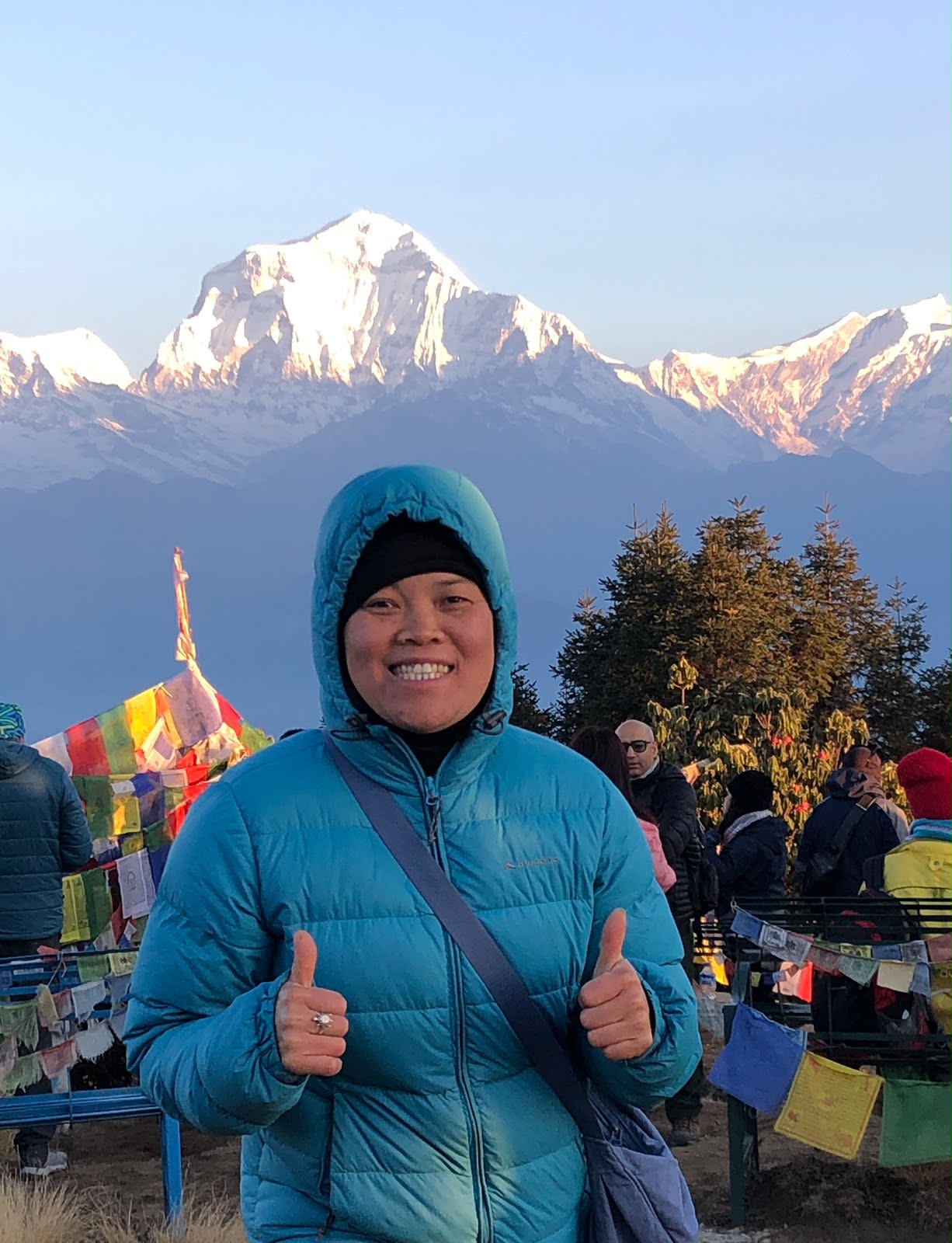
Poon Hill (3,210 m) is the viewpoint above Ghorepani that most people remember long after the trek. The 45-minute climb from the village on stone steps delivers a sunrise view across Dhaulagiri (8,167 m), the full Annapurna massif, and Machhapuchhre to the east. The colour starts about 20 minutes before the sun clears the ridge and changes quickly, so arriving by 05:30 matters.
The final approach to ABC passes through Machhapuchhre Base Camp (3,700 m) and then climbs a further 430 metres on a rocky trail to the sanctuary floor. At 4,130 metres the air contains roughly 61 percent of the oxygen available at sea level. Most trekkers feel mild breathlessness and a dull headache on arrival. Both usually resolve overnight with rest, water, and garlic soup. We build the itinerary so that you spend one night at ABC and descend the following morning.
Jhinu Danda hot springs at 1,780 metres sit just off the descent trail near Chomrong, a 20-minute detour beside the Modi Khola river. The geothermal pools hold around 40 degrees Celsius year-round and are the standard way to finish the trek before the drive back to Pokhara.
The best months are March, April, October, and November. Spring brings flowering rhododendrons and stable weather. Autumn delivers the clearest skies of the year after the monsoon clears. The monsoon runs June to September, making the trail muddy and leech-prone but never closed. December and January are cold but possible with the right gear.
Upcoming departures.
| Start Date | End Date | Price / Person | Availability | |
|---|---|---|---|---|
| Oct 25, 2026 | Nov 4, 2026 | USD 940 | 7 spots left | |
| Nov 8, 2026 | Nov 18, 2026 | USD 890 | 10 spots left | |
| Apr 11, 2027 | Apr 21, 2027 | USD 920 | 12 spots left | |
| Oct 10, 2027 | Oct 20, 2027 | USD 960 | 12 spots left |
6 moments you won't forget.
The Annapurna Sanctuary at 4,130 metres
A glacial amphitheatre enclosed on all sides by some of the highest peaks on earth. Annapurna I (8,091 m), Annapurna South (7,219 m), Hiunchuli (6,441 m), Gangapurna (7,455 m), and Machhapuchhre (6,993 m) form a near-continuous ring of rock and ice around you. The sanctuary covers 117 square kilometres and is protected as part of the Annapurna Conservation Area, the first conservation area established in Nepal in 1986.
Poon Hill sunrise over the Annapurna massif
At 3,210 metres above Ghorepani, the hilltop viewpoint delivers a pre-dawn panorama spanning over 80 kilometres of peaks. Dhaulagiri (8,167 m) sits to the northwest, the full Annapurna range fills the north, and Machhapuchhre's perfect double-summit pyramid anchors the east. The climb from Ghorepani village takes 45 minutes on stone steps and should begin by 05:15 to catch the colour before cloud builds.
Nepal's largest rhododendron forest
The trail between 1,900 and 2,900 metres runs through the most extensive Rhododendron arboreum forest in Nepal. Individual trees reach 12 metres in height and can be several hundred years old. In March and April they flower simultaneously, turning entire ridge lines red and pink. The forest is also home to red pandas, Himalayan black bears, and the impeyan pheasant, Nepal's national bird.
The Modi Khola gorge approach
From Dovan onward, the trail follows the Modi Khola river through a gorge that narrows to barely 50 metres across in places. The walls rise vertically on both sides and the vegetation shifts abruptly from rhododendron forest to bamboo and then to bare rock. This section is the most dramatic hour of walking on the trek and the moment when most trekkers first understand the scale of what they are walking into.
Chomrong village and Gurung hospitality
Chomrong sits at 2,170 metres on a ridgeline overlooking the Chomrong Khola valley. It is the largest Gurung village on the route and the last permanent settlement before the sanctuary. The village has around 400 residents, a monastery, a police checkpoint, and a dozen teahouses. Many lodge families have been hosting trekkers since the 1980s and the hospitality here is notably warm even by Nepalese standards.
Jhinu Danda hot springs
A 20-minute detour from the descent trail near Chomrong brings you to a series of natural geothermal pools beside the Modi Khola river at 1,780 metres. The water temperature holds around 40 degrees Celsius year-round. Finishing the trek with a hot spring soak before the drive back to Pokhara has become the standard way to end an ABC trek, and most groups plan for two to three hours here.
Interactive circuit map.
The full 11–13-day circuit on a topographic map. Click any marker for details. Switch between Topo, Satellite, and Standard views using the layer control.
11–13 days. Every detail planned.
Transparent, all-in pricing.
Included in your price
Not included
Trek altitude at a glance.
How hard is this trek?
Best time for the Annapurna Base Camp Trek.
Weather on the Annapurna Base Camp Trek.
Everything you need to know.
Open any card for in-depth notes on accommodation, food, altitude, permits, money and the small print that matters on the trail.
Your safety, planned in detail.
Altitude is the main risk on this trek. Here is exactly what we carry, who we call, and where the nearest help is at every stage of the route.
Common health risks
- •Mild AMS possible above 3,500m, uncommon but watch for it
- •Knee strain, the 3,200-step descent into Chhomrong is brutal
- •Dehydration in the Modi Khola gorge (humid, low elevation)
- •Leech bites in monsoon-shoulder months (May–September)
- •Stomach upset: purify all water below 2,500m especially
- •Blisters: the high-step trail is hard on feet
Our medical kit
- •Pulse oximeter (carried by guide, checks oxygen saturation)
- •Emergency oxygen cylinder (lead guide carries one above 4,000m)
- •Diamox (acetazolamide) for acute mountain sickness
- •Dexamethasone (HACE emergency use)
- •Nifedipine (HAPE emergency use)
- •Broad-spectrum antibiotics
- •Anti-diarrhoeal medication
- •Antihistamines
- •Strong painkillers (ibuprofen + paracetamol)
- •Wound dressings, blister kit, bandages
- + 3 more items carried by the lead guide
Travel insurance — required
- ✓Must cover trekking up to 4,200m (ABC sits at 4,130m)
- ✓Must include helicopter evacuation (USD 5,000+ coverage minimum)
- ✓Must include medical and emergency repatriation
- ✓We recommend World Nomads, True Traveller (UK), or Safety Wing, all cover Nepal trekking at altitude
- ✓Bring policy printout + emergency phone number to the pre-trek briefing
Nearest medical facilities
- •Chhomrong: Basic health post with first aid
- •Pokhara: Manipal Teaching Hospital, best regional emergency care, 30 min by road from Nayapul
- •Pokhara: CIWEC clinic (branch of Kathmandu), altitude and travel medicine
- •Kathmandu: CIWEC Travel Medicine Centre, referral specialty altitude care
Emergency protocols
Guides carry pulse oximeter and check saturation daily from Dovan onward. Helicopter evacuation is available from any point on the route; nearest landing pads at Chhomrong, Sinuwa, and ABC itself. The trail descent to road head is feasible in 1.5 days from ABC in a true emergency. We coordinate with Simrik Air and Mountain Helicopters.
Helicopter evacuation
Helicopter evacuation from ABC to Pokhara: USD 3,500–4,500, fully reimbursable by qualifying insurance. From Chhomrong/Sinuwa: USD 2,500–3,500. Helipads exist at most major villages on the route. Response time 30–60 minutes from Pokhara in good weather.
Nepal visa on arrival
Tourist visa-on-arrival at Kathmandu (Tribhuvan International) airport. USD 30 / 15 days, USD 50 / 30 days, USD 125 / 90 days. Bring 2 passport photos and USD cash. The arrival kiosk takes credit cards but with a 4–5% surcharge. Process takes 15–30 minutes on arrival depending on flight load.
From your front door to the trailhead.
Every leg of the journey, the mode of transport, the time it takes, and what's included. The complete picture from international arrival to trek start and back again.
International airport → Kathmandu hotel
IncludedIncluded
Kathmandu → Pokhara
IncludedIncluded (your choice)
Pokhara → Nayapul
IncludedIncluded
Nayapul → Pokhara (return)
IncludedIncluded
Pokhara → Kathmandu
IncludedIncluded
What to pack.
Plan Your Trek
Planning guides for the Annapurna Base Camp Trek
Written by our guides, these cover the permits, altitude, timing, and kit you need before you go.
Common questions.
FitnessHow fit do I need to be for the Annapurna Base Camp trek?+
You need a good base of cardiovascular fitness. If you walk regularly and can sustain 5 to 6 hours of uphill hiking without stopping, you are ready. Specific preparation that helps: running or cycling 30 minutes four times per week for 6 weeks before departure, practising stair climbing with a loaded daypack, and two weekend day hikes of 4 to 5 hours each. The hardest single section is the 3,600 stone steps from Tikhedhunga to Ulleri on Day 3 — experienced walkers handle it in 90 minutes.
FitnessIs the Annapurna Base Camp trek harder than Everest Base Camp?+
No. ABC (4,130 m) is lower than EBC (5,364 m) by 1,234 metres and the trek is rated moderate compared to EBC's strenuous rating. The total trekking days are fewer and the altitude gain per day is more gradual. Most trekkers with average fitness complete ABC without significant difficulty. EBC requires stronger fitness, better altitude tolerance, and more preparation time.
HealthCan I get altitude sickness on the ABC trek?+
Yes, altitude sickness is possible above 3,000 m on any trek, including ABC. Mild AMS — headache, fatigue, nausea — is common at Deurali (3,200 m) and ABC (4,130 m). Our itinerary is designed to ascend slowly, giving your body time to adapt. Our guides carry a pulse oximeter and check your blood-oxygen saturation each morning above 3,000 m. If your symptoms worsen after rest, we descend immediately. Most cases resolve within 24 hours of losing 300 to 500 metres of altitude.
HealthDo I need Diamox (acetazolamide) for this trek?+
It is worth discussing with your doctor before travel. Diamox at 125 mg twice daily, starting the morning you leave Deurali, reduces the incidence of AMS and is widely used on this route. It is a prescription medication in most countries. Side effects include increased urination, mild tingling in the fingers, and sensitivity to sunlight — all manageable. If you are allergic to sulfa drugs, Diamox is contraindicated. Ibuprofen 400 mg three times daily is a commonly used alternative.
PlanningWhat permits are needed and are they included in the price?+
Two permits are required: the Annapurna Conservation Area Permit (ACAP, approximately USD 23) and the TIMS Card (Trekkers' Information Management System, approximately USD 15 for agency-booked trekkers). Both are included in your package price. We obtain them in Pokhara on the morning before the trek starts. You need to provide a copy of your passport data page and one passport photo in advance.
PlanningWhat is the best time of year to do the ABC trek?+
October and November are the best months: stable weather, clear skies, and the best mountain views of the year after the monsoon clears. March and April are the second-best window, with rhododendron forests in full bloom from 1,900 to 2,900 metres. May is still good but afternoon cloud builds more frequently. The monsoon (June to September) keeps the trail open but views are limited and leeches are prevalent below 2,500 m. December to February is cold but possible with proper winter gear.
PlanningHow many days does the Annapurna Base Camp trek take?+
Our standard itinerary is 11 days total: 1 day in Pokhara before the trek, 9 days on the trail, and 1 departure day. This gives a comfortable pace without rushing the ascent. Shorter 9-day or 10-day itineraries exist but compress the upper section, increasing AMS risk and reducing time at the sanctuary. If you have additional days, a visit to Ghandruk village or a night at Jhinu hot springs can be added without significant effort.
PlanningDo I need a guide, or can I trek independently?+
You are not legally required to have a guide on this route, but we recommend one for several practical reasons. The route is well-marked in good weather but navigation is difficult in fog or snow above 3,000 m. AMS decisions are safer with an experienced person making the call. Your guide also handles permit checks, lodge bookings during busy season, and emergency coordination. As of 2023, the Nepal government has been considering making guides mandatory on major routes including ABC; check current regulations before departure.
FoodWhat food is available on the trek?+
Teahouse menus on this route are regulated by the ACAP and offer broadly the same items at every lodge. Dal bhat (lentil soup, rice, vegetable curry) is the safest and most filling option and comes with free refills. Other reliable choices include Tibetan bread with honey, porridge, fried rice, noodle soup, vegetable momos, and garlic soup. Avoid meat above Dovan as there is no refrigeration. All your trek meals (breakfast, lunch, dinner) are included in the package. Drinks — tea, coffee, hot lemon, bottled water — are personal expense.
PlanningIs there WiFi on the Annapurna Base Camp trek?+
WiFi is available in teahouses from Tikhedhunga through to Deurali, with the best connection at Ghorepani and Chomrong. At Deurali and in the sanctuary (MBC and ABC), WiFi exists but is slow and unreliable. Mobile data (Ncell or Nepal Telecom) covers the lower valleys below Chomrong on 4G and is patchy on 3G up to Deurali. Above Deurali, assume no connectivity. A local SIM from Pokhara (around NPR 500) is the cheapest way to stay connected in the lower sections.
SafetyWhat happens if I need to be evacuated?+
Helicopter evacuation is the standard response for serious medical emergencies above 3,000 m. Your travel insurance (which we require) must cover helicopter evacuation to at least USD 100,000. We pre-register your policy with our helicopter operators in Kathmandu before departure so there is no delay in a real emergency. If a guide decides evacuation is needed, we authorise the helicopter immediately. Payment goes through your insurer; we will never delay a medical decision for billing reasons. Nearest hospitals with altitude-medicine capacity are in Pokhara.
SafetyIs the trek safe for women travelling solo?+
Yes. The Annapurna trail is one of the most travelled trekking routes in Nepal and is generally safe for solo female trekkers. Our female solo clients consistently report feeling comfortable and respected throughout the trek. The most practical precautions: trek with a licensed guide from a registered company (which you are doing if you book with us), avoid walking after dark, and book lodges in advance during peak season so you are not isolated in an unfamiliar place without a confirmed bed.
InsuranceWhat insurance do I need for the ABC trek?+
Your policy must cover trekking activity to at least 4,500 m (ABC is 4,130 m), helicopter evacuation to USD 100,000, emergency medical treatment, and trip cancellation. Policies capped at 3,000 m or 4,000 m are not sufficient. Providers that reliably cover Nepal trekking include World Nomads (Explorer plan), True Traveller, Safety Wing Nomad, and IMG Global. Bring a printed copy with the 24-hour emergency number to your pre-trek briefing in Pokhara.
Built different. On purpose.
Named lead guide before you book
Every booking is paired with a specific TAAN Class-A licensed guide whose name, photo, licence number, and WhatsApp contact we share at confirmation. The same guide meets you at Pokhara airport and finishes the trek with you. No swaps, no last-minute substitutions.
Private trek, your group only
We have never placed strangers together on a private departure since the company opened in 2009. Your group sets the pace, chooses the meal timing, and decides on rest stops. Group sizes run from one trekker to twelve; the trail is shared with others, the experience is not.
All-in pricing, nothing owed on the trail
The quoted price covers permits (ACAP and TIMS), guide and porter fees, all 29 trek meals, teahouse and hotel accommodation, ground transport Pokhara to Nayapul and back, and 24-hour evacuation coordination. Personal spending on trail: hot showers, charging, WiFi, drinks, and tips.
60-day free cancellation, low deposit
A small deposit holds your date. Cancellations more than 60 days before departure receive a full refund minus a USD 100 admin fee. Medical-emergency cancellations any time before departure convert to a 12-month booking credit with no penalty.