Poon Hill Trek
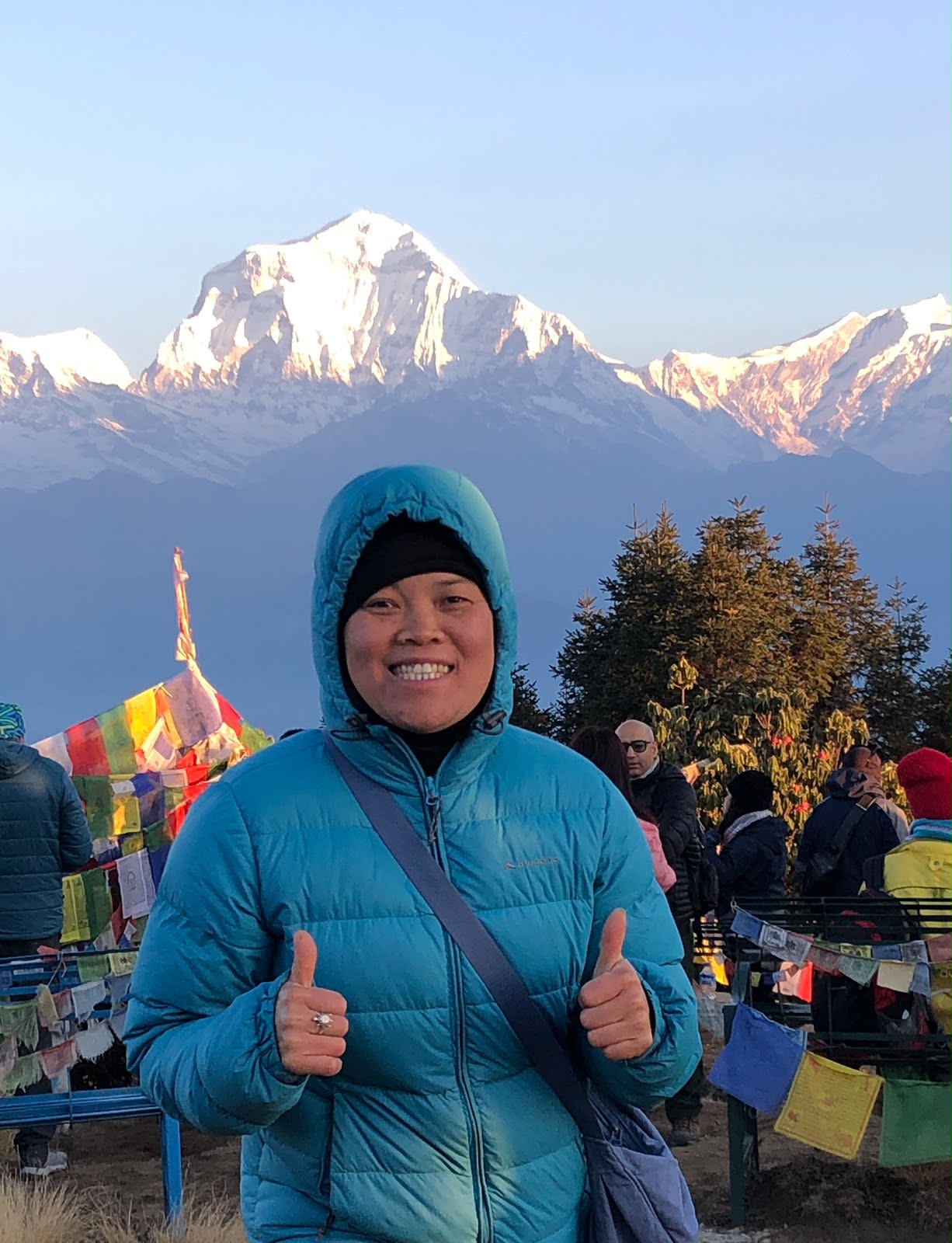
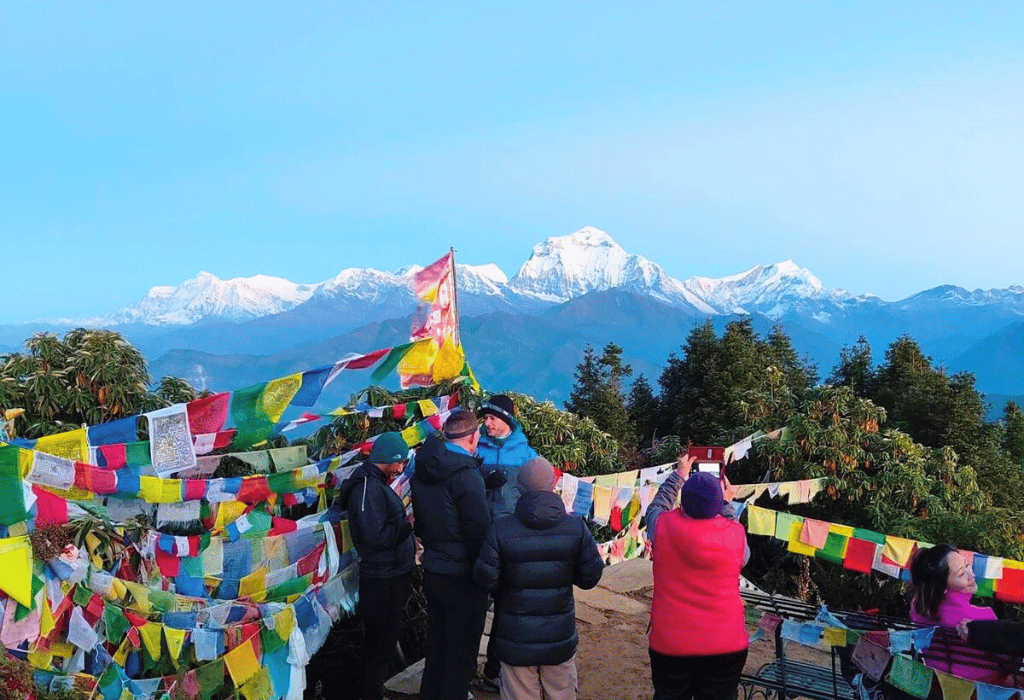
Poon Hill stands at 3,210 metres above the Annapurna foothills and delivers one of the best sunrise panoramas in Nepal. From the hilltop viewpoint the full Annapurna range stretches across the northern horizon, Dhaulagiri (8,167 m) to the west, Annapurna I (8,091 m) and Annapurna South (7,219 m) ahead, and Machhapuchhre (Fishtail, 6,993 m) to the east. The view covers more than 80 kilometres of Himalayan ridgeline and changes colour for about 30 minutes as the sun clears the peaks.
The trek takes 5 days and travels in a loop through the Annapurna foothills. It starts at Nayapul (1,070 m), climbs through Tikhedhunga and the stone staircase village of Ulleri to reach Ghorepani (2,874 m) on Day 2. Day 3 begins with the 45-minute pre-dawn climb to Poon Hill for sunrise, then crosses through rhododendron forest to Tadapani (2,630 m). Day 4 descends to the large Gurung village of Ghandruk (1,940 m) and continues down to Nayapul. The total distance is around 50 kilometres with approximately 1,800 metres of cumulative elevation gain.
There is no altitude sickness risk on this trek. Poon Hill's maximum elevation of 3,210 metres is well below the threshold where altitude becomes a medical concern, and the ascent is gradual. This makes it the right choice for first-time trekkers, people over 60, families with children aged 8 and up, and anyone wanting a short, manageable introduction to Himalayan trekking.
The rhododendron forest between Ghorepani and Tadapani is among the finest in Nepal. Rhododendron arboreum trees here reach 15 metres in height and in March and April they flower simultaneously across entire ridge lines in shades of red, pink, and white. This section of trail, between 2,400 and 2,800 metres, is where most people stop and simply look for a while.
Ghorepani is a small village of around 50 households at 2,874 metres. All residents are Magar people. Every house in the village doubles as a teahouse and the hospitality is straightforward and genuine. The lodges here have proper beds, blankets, and dining rooms with wood-burning stoves. Most evenings involve a communal dinner with other trekking groups and the guides eating together.
Ghandruk is the main Gurung village on the route and one of the largest traditional villages in the Annapurna region, with around 1,300 permanent residents. The village has a museum dedicated to Gurung culture and a monastery at the upper end. The stone-paved lanes and slate-roofed houses have remained largely unchanged for generations.
This trek is the right one if you have four or five days, no high-altitude ambition, and want to understand what Himalayan trekking actually looks and feels like. The walking is mostly on stone staircase trails that Gurung villagers have used for hundreds of years. The food is good, the lodges are welcoming, and the sunrise from Poon Hill on a clear morning makes the whole trip worthwhile within the first hour of Day 3.
Upcoming departures.
| Start Date | End Date | Price / Person | Availability | |
|---|---|---|---|---|
| Nov 1, 2026 | Nov 5, 2026 | USD 390 | 8 spots left | |
| Apr 4, 2027 | Apr 8, 2027 | USD 410 | 12 spots left | |
| Oct 10, 2027 | Oct 14, 2027 | USD 430 | 12 spots left |
6 moments you won't forget.
Sunrise from Poon Hill (3,210 m)
The viewpoint sits on a rounded hilltop above Ghorepani village. A stone staircase of roughly 400 steps leads up in 40 to 45 minutes from the village. Most trekkers start the climb at 05:00 to 05:15 and arrive before first light. The view spans Dhaulagiri (8,167 m) to the northwest and the Annapurna massif to the north, with Machhapuchhre's sharp pyramid to the east. The colour show lasts about 25 minutes as sunlight descends from summit to ridge to valley. A small government observation tower on the hill extends the view slightly and is worth climbing in addition to the main viewpoint.
Nepal's finest rhododendron forest
The trail between Ghorepani and Tadapani passes through a Rhododendron arboreum forest that is consistently rated among the best in Asia. Trees here are 100 to 200 years old, stand up to 15 metres tall, and have trunk diameters of 30 to 60 centimetres. In March and April they bloom simultaneously, entire hillsides turn red, pink, and white over a period of two to three weeks. Nepal declared Rhododendron arboreum its national flower in 1962. This section of trail, around 2,600 metres altitude, is the finest place in the country to see it in bloom.
Ghorepani village and Magar hospitality
Ghorepani sits at 2,874 metres on a ridge connecting the Annapurna and Dhaulagiri trail systems. The village has around 50 households, all operating as teahouses. The residents are Magar people who settled this ridge approximately 500 years ago. Magar is one of Nepal's officially recognised indigenous nationalities with a distinct language, dress, and farming tradition. Teahouse meals at Ghorepani are prepared by the families who own the lodges, the dal bhat here is consistently excellent, and the wood-burning stove in the dining room is the social centre of the village on cold evenings.
Ghandruk: the largest Gurung village
Ghandruk village sits at 1,940 metres and has around 1,300 permanent residents, making it one of the largest traditional villages in the Annapurna region. The stone-paved lanes, slate-roofed houses, and terraced fields above the Modi Khola valley have been maintained largely unchanged for generations. The village has a Gurung Museum, a gompa (monastery), a health post, and a community forest above the upper houses. Gurung soldiers have served in the British and Indian Gurkha regiments for over 200 years, the museum documents this history alongside traditional farming and weaving practices.
The Ulleri stone staircase
The climb from Tikhedhunga (1,480 m) to Ulleri (2,070 m) is one of the most famous sections of trail in the Annapurna foothills. A continuous stone staircase of approximately 3,000 steps rises 600 metres in about 1.5 hours. The steps were hand-cut over generations by local villagers and are still maintained by the communities above. This section requires no particular fitness beyond a steady pace, but it is relentlessly uphill and best taken slowly with regular short breaks. From Ulleri the views south across the Annapurna foothills begin to open up.
A complete trekking loop: no backtracking
The standard Poon Hill route is a true loop. You ascend via Nayapul, Tikhedhunga, and Ulleri on the Ghorepani side, then descend via Tadapani and Ghandruk on the Annapurna Sanctuary trail. The two legs of the loop cover entirely different terrain and villages. No significant section of trail is repeated. The descent through Tadapani and Ghandruk offers views toward the Annapurna Sanctuary that the ascent leg does not, making the route feel like two distinct experiences in a single trek.
Interactive circuit map.
The full 5-day circuit on a topographic map. Click any marker for details. Switch between Topo, Satellite, and Standard views using the layer control.
5 days. Every detail planned.
Transparent, all-in pricing.
Included in your price
Not included
Trek altitude at a glance.
How hard is this trek?
Best time for the Poon Hill Trek.
Weather on the Poon Hill Trek.
Everything you need to know.
Open any card for in-depth notes on accommodation, food, altitude, permits, money and the small print that matters on the trail.
Your safety, planned in detail.
Altitude is the main risk on this trek. Here is exactly what we carry, who we call, and where the nearest help is at every stage of the route.
Common health risks
- •Knee strain, the 3,200 stone steps to Ghorepani are demanding
- •Cold mornings at Poon Hill viewpoint (0°C to -5°C even in October)
- •Blisters from new boots
- •Mild dehydration in dry winter air
- •Slippery steps in monsoon shoulder months
Our medical kit
- •Pulse oximeter (carried by guide, checks oxygen saturation)
- •Emergency oxygen cylinder (lead guide carries one above 4,000m)
- •Diamox (acetazolamide) for acute mountain sickness
- •Dexamethasone (HACE emergency use)
- •Nifedipine (HAPE emergency use)
- •Broad-spectrum antibiotics
- •Anti-diarrhoeal medication
- •Antihistamines
- •Strong painkillers (ibuprofen + paracetamol)
- •Wound dressings, blister kit, bandages
Travel insurance — required
- ✓Must cover trekking up to 3,300m (Poon Hill is 3,210m)
- ✓Must include helicopter evacuation (USD 5,000+ coverage minimum)
- ✓Must include medical and emergency repatriation
- ✓We recommend World Nomads, True Traveller (UK), or Safety Wing, all cover Nepal trekking at altitude
- ✓Bring policy printout + emergency phone number to the pre-trek briefing
Nearest medical facilities
- •Ghorepani: Basic health post
- •Pokhara: Manipal Teaching Hospital (60 min by road from Nayapul)
- •Pokhara: CIWEC clinic
Emergency protocols
Poon Hill trek operates entirely below 3,300m, so altitude is not a meaningful concern. Helicopter rescue available from any point, Pokhara hospital is 60 minutes by road. Family-friendly trek with low-stakes safety profile.
Helicopter evacuation
Helicopter from Ghorepani to Pokhara: USD 2,200–3,000, covered by insurance. Quick response (30 min from Pokhara).
Nepal visa on arrival
Tourist visa-on-arrival at Kathmandu (Tribhuvan International) airport. USD 30 / 15 days, USD 50 / 30 days, USD 125 / 90 days. Bring 2 passport photos and USD cash. The arrival kiosk takes credit cards but with a 4–5% surcharge. Process takes 15–30 minutes on arrival depending on flight load.
From your front door to the trailhead.
Every leg of the journey, the mode of transport, the time it takes, and what's included. The complete picture from international arrival to trek start and back again.
International airport → Kathmandu hotel
IncludedIncluded
Kathmandu → Pokhara
IncludedIncluded
Pokhara → Nayapul
IncludedIncluded
Nayapul → Pokhara
IncludedIncluded
What to pack.
Plan Your Trek
Planning guides for the Poon Hill Trek
Written by our guides, these cover the permits, altitude, timing, and kit you need before you go.
Common questions.
FitnessIs the Poon Hill Trek suitable for beginners with no trekking experience?+
Yes. Poon Hill is the most accessible multi-day Himalayan trek in Nepal and is specifically designed for people who have never trekked before. The trails are well-marked stone paths, the maximum altitude is 3,210 metres (no altitude sickness risk), and the teahouses are comfortable. The only genuinely demanding section is the Tikhedhunga to Ulleri stone staircase on Day 2 — approximately 3,000 steps over 1.5 to 2 hours. It is steep but straightforward. Take it slowly, rest when needed, and it is very manageable.
FitnessWhat is the minimum age for children on the Poon Hill Trek?+
Children from age 8 upward can comfortably complete the Poon Hill Trek with a moderate level of fitness. The Ulleri staircase (Day 2) is the section that younger children sometimes find challenging — it involves a lot of steps. Children aged 10 and over are usually completely comfortable. We have guided families with children aged 8 and up on this route many times. Younger children (5–7) are possible with a dedicated porter to carry them for tired sections, which we can arrange on request.
HealthIs there any altitude sickness risk on the Poon Hill Trek?+
No significant risk. The maximum altitude is 3,210 metres at Poon Hill viewpoint. Altitude sickness (AMS) typically begins to affect people at 3,500 metres and above, and only if ascent is too rapid. The Poon Hill route gains altitude gradually over 2 days, which gives your body enough time to adapt. If you feel a mild headache above 2,500 m, drink water, slow your pace, and rest. Symptoms at this altitude almost always resolve within 1 to 2 hours. No altitude medication is required.
HealthWhat is the weather like on the Poon Hill Trek?+
The best conditions are in October and November (post-monsoon) and March and April (spring). October and November bring clear skies and stable weather — the chance of a clear Poon Hill sunrise is approximately 80 to 85 percent. Temperatures at Ghorepani (2,874 m) run 10–15°C during the day and 3–8°C at night in October, dropping to -2°C at night by late November. March and April are warmer with rhododendrons in bloom, but with slightly higher cloud risk in the mornings. The monsoon runs June to September with daily rain and frequent cloud cover at Poon Hill — not recommended for the sunrise experience.
PlanningWhat is the best time of year to do the Poon Hill Trek?+
October is the best single month — clearest skies, most reliable sunrise, good temperature. November is nearly as good and noticeably quieter. March and April are the best for forest colour (rhododendrons bloom from mid-March through April). April is the busiest month on this trail — pre-booking your Ghorepani accommodation well in advance is essential. December to February is cold but possible with proper gear, and the trail is rarely crowded. June to September (monsoon) is open but not recommended for the Poon Hill experience.
PlanningWhat permits do I need and are they included in the price?+
Two permits are required: the Annapurna Conservation Area Permit (ACAP, USD 30 per person) and the TIMS card (included in agency group TIMS when trekking with us). Both permits are included in your package price. We arrange them in Pokhara before the trek. Bring your passport and two passport-size photos for the ACAP application.
PlanningHow much extra cash should I bring for personal spending on the trail?+
Budget NPR 3,000 to 5,000 (USD 22–38) for the full trek. This covers hot showers (NPR 150–300 per shower, available at all teahouses), phone charging (NPR 100–200 per session), Wi-Fi (NPR 100–200 per day where available), soft drinks, coffee, chocolate bars, and any extra snacks. There are no ATMs between Pokhara and Pokhara. Withdraw enough Nepali Rupees in Pokhara before departure.
PlanningCan I do Poon Hill solo without a guide?+
Since April 2023, Nepal requires all foreign trekkers to be accompanied by a licensed guide. Independent trekking without a guide is no longer permitted under the Tourism Board regulation that covers all trekking areas including the Annapurna Conservation Area. This regulation was introduced to improve trekker safety and support the local guiding industry. We offer a guide-only option for trekkers who want to arrange their own permits, accommodation, and food.
FoodWhat is the food like at the teahouses?+
Teahouse food on the Poon Hill route is simple and good. Dal bhat — lentil soup with rice, vegetable curry, and pickle — is the staple and is served with unlimited refills. The dal bhat at Ghorepani is particularly good. Most teahouses also serve noodles, pasta, porridge, eggs, Tibetan bread, and garlic soup. Vegetarian options make up the majority of the menu. Notify us of any dietary restrictions before the trek and we will brief each teahouse in advance. Vegan, gluten-free, and nut-allergy diets are all manageable.
SafetyWhat happens if the Poon Hill sunrise is cloudy?+
Cloud is a real possibility — the sunrise is clear approximately 80 to 85 percent of the time in October and November, and around 70 percent in spring. If cloud covers the view on your sunrise morning, the guide will assess conditions. If the weather window looks possible, most groups wait at the viewpoint until 07:00 before descending. We do not build a buffer day into the standard 5-day itinerary, but the trip can be extended by one night in Ghorepani for NPR 3,000–5,000 per person in extra teahouse costs if you want a second attempt. Discuss this with the guide on Day 3 if the first morning is cloudy.
SafetyIs the Ulleri stone staircase actually as hard as people say?+
It depends on your expectations. The staircase from Tikhedhunga to Ulleri is approximately 3,000 steps and rises 600 metres in 1.5 to 2 hours. It is unrelentingly uphill and steep. For people who exercise regularly, it is a tough but manageable climb. For people who have done no training, it is genuinely hard. The trick is pace — go slower than you think you need to, stop every 15 to 20 minutes for 2 to 3 minutes, and drink water regularly. The good news: it is over in 2 hours, the steps are well-cut and stable, and you will not need to do it again (the descent is via Ghandruk, a different trail).
InsuranceWhat travel insurance do I need?+
For the Poon Hill Trek, a standard travel insurance policy with trekking cover to 4,000 metres is sufficient — the trek only reaches 3,210 m. The policy should cover medical evacuation and trip cancellation. Most travel insurance policies include trekking at this altitude without an adventure sports rider. Check your policy to confirm. We recommend carrying a printed copy of your policy and the emergency contact number on the trail. Helicopter evacuation from the Poon Hill area reaches Pokhara in under 15 minutes, and the cost (USD 1,500–2,000) is almost always covered by travel insurance.
Built different. On purpose.
Named lead guide before you book
Every booking is paired with a TAAN Class-A licensed guide whose name, photo, and WhatsApp contact we share at confirmation. The same guide meets you in Pokhara and finishes the trek with you.
Private trek, your group only
We never mix strangers into private departures. Group sizes run from 1 to 12. Your group sets the pace and decides on rest stops. The trail is shared with others; the experience is not.
All-in pricing, nothing owed on the trail
The quoted price covers permits (ACAP and TIMS), guide and porter fees, all 15 trek meals, teahouse and hotel accommodation, and ground transport Pokhara to Nayapul and back. Personal spending: hot showers, charging, Wi-Fi, drinks, and tips.
60-day free cancellation, low deposit
A small deposit holds your date. Cancellations more than 60 days out receive a full refund minus USD 100. Medical-emergency cancellations convert to a 12-month booking credit with no penalty.