Eight of the world's 14 eight-thousanders stand wholly or partly inside Nepal, from Mount Everest at 8,848.86m (29,032ft) down to Annapurna I at 8,091m (26,545ft). An eight-thousander is a mountain whose summit rises higher than 8,000 metres above sea level, and only 14 of them exist anywhere on Earth.
Why these giants matter on a Nepal trek
Nepal holds 8 of the planet's 14 highest mountains, and that is the reason so many people fly into Kathmandu with a duffel bag and worn-in boots. You do not have to climb these peaks to stand beneath them. Our walking routes carry you to viewpoints and base areas where these summits fill the whole sky, with no ropes or ice axes needed.
14 eight-thousanders exist in total, and 8 of them rise wholly or partly in Nepal. That is why one trekking country can offer so many big-mountain views in a single trip. Walk two or three of our routes and you can stand under four different eight-thousanders: Everest, Annapurna I, Manaslu and Dhaulagiri I.
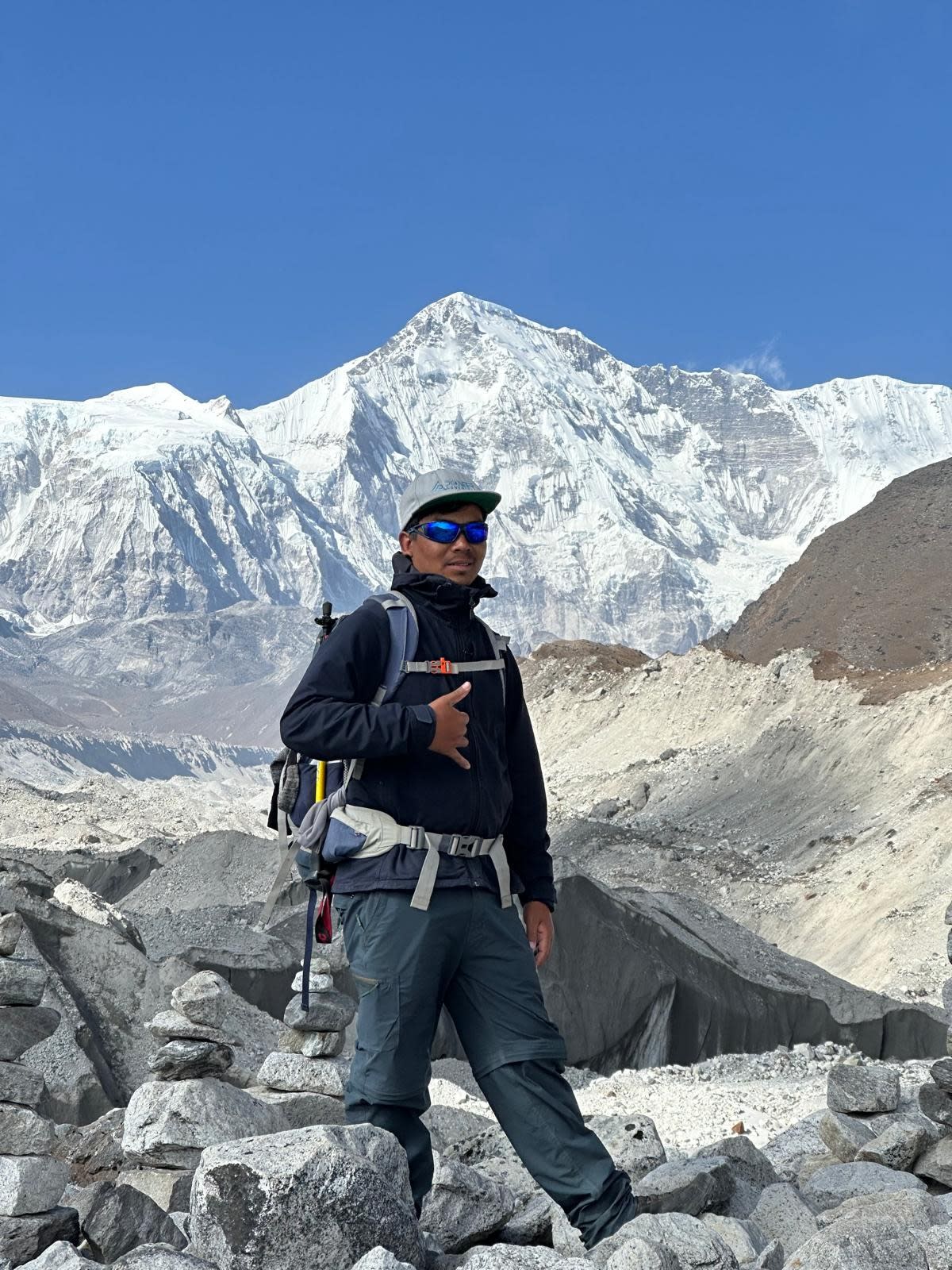
Everest anchors the far side of that group, and the classic Everest Base Camp trek walks you to the foot of it. Manaslu, the eighth peak on the height list, stands over the Manaslu Circuit trek, which loops right around its base. Annapurna I closes off the head of the Annapurna Sanctuary, the natural amphitheatre you reach on the Annapurna Base Camp trek. Dhaulagiri I, meanwhile, shows itself across the valley from the Poon Hill area at first light.
The 8 eight-thousanders in Nepal, by height
Everest tops the list at 8,848.86m, and the other seven step down from there. Three of the eight sit entirely inside Nepal's borders. The other five are shared, with the summit or the ridgeline marking the frontier with China or with India.
| Peak | Height (m) | Height (ft) | Border |
|---|---|---|---|
| Everest | 8,848.86 | 29,032 | Nepal-China |
| Kangchenjunga | 8,586 | 28,169 | Nepal-India (Sikkim) |
| Lhotse | 8,516 | 27,940 | Nepal-China |
| Makalu | 8,485 | 27,838 | Nepal-China |
| Cho Oyu | 8,188 | 26,864 | Nepal-China |
| Dhaulagiri I | 8,167 | 26,795 | Wholly in Nepal |
| Manaslu | 8,163 | 26,781 | Wholly in Nepal (Gorkha) |
| Annapurna I | 8,091 | 26,545 | Wholly in Nepal (Gandaki) |
8,848.86m down to 8,091m is a spread of only about 758 metres across all eight peaks, which shows how tightly the world's highest mountains are packed into and around Nepal. Every one of them clears 8,000m, the round line that separates the 14 tallest mountains on Earth from everything below.
How the eight compare in height
8,848.86m and 8,091m mark the top and bottom of Nepal's list, a gap of about 758 metres. Between them the peaks fall in uneven steps. Everest stands 262.86m above Kangchenjunga, the second-highest of them. Kangchenjunga is 70m above Lhotse, and Lhotse sits just 31m above Makalu. Cho Oyu, Dhaulagiri I, Manaslu and Annapurna I are all packed within 97 metres of one another, from 8,188m down to 8,091m.
The three that belong entirely to Nepal
Dhaulagiri I, Manaslu and Annapurna I are the only eight-thousanders that lie fully on Nepali soil. Dhaulagiri I rises to 8,167m (26,795ft). Manaslu reaches 8,163m (26,781ft) in the Gorkha district. Annapurna I stands at 8,091m (26,545ft) in the Gandaki region, the lowest of the world's 14 eight-thousanders, though by no means an easy mountain.
Dhaulagiri I and Manaslu are separated by just 4 metres in height, 8,167m against 8,163m, which makes them near twins near the foot of the eight-thousander list. Both peaks, along with Annapurna I, belong to Nepal alone, with no ridgeline shared across a border. For a trekker, that means the Manaslu Circuit and the walk into the Annapurna Sanctuary stay inside Nepal from the first day to the last.
8 of the 14 highest mountains on Earth stand along a single line, Nepal's northern border. That border runs for hundreds of kilometres against China, with one corner touching India, and the giant peaks are strung along it like beads on a thread. It is the reason a small country holds so much of the world's highest ground, and why a trekker in Nepal is rarely far from an eight-thousander.
The five that share a border
Everest, Lhotse, Makalu and Cho Oyu all straddle the border between Nepal and China. Kangchenjunga is the exception, sharing its frontier with India, where its eastern side falls into Sikkim. Kangchenjunga is also the tallest of these shared peaks at 8,586m (28,169ft), second only to Everest among all of Nepal's eight-thousanders.
Everest and Lhotse both share the same frontier with China, standing 332.86m apart in height. Makalu and Cho Oyu are the other two peaks in Nepal's China-border group, at 8,485m and 8,188m. Kangchenjunga is the only one of the eight that Nepal shares with India, on the Sikkim side.
A closer look at each of the eight peaks
Everest, at 8,848.86m (29,032ft), is the highest mountain on Earth and shares its summit ridge between Nepal and China. It is the peak that pulls most trekkers to the country. You reach its base on the Everest Base Camp trek, a walk rather than a climb, which is why an ordinary fit person can stand beneath the world's highest point.
Kangchenjunga, at 8,586m (28,169ft), is the second-highest of Nepal's eight-thousanders and the only one that shares a border with India, on the Sikkim side. It rises in the far eastern corner of the country. This is remote, quiet ground that sees far fewer walkers than Everest or Annapurna, and our most popular routes lie further west.
Lhotse, at 8,516m (27,940ft), stands on the Nepal-China border and is third on Nepal's height list, 332.86m below Everest. It is one of the four peaks Nepal shares with China. Lhotse is climbing country more than a trekking goal, so on our routes walkers take in the high Everest region rather than stand at Lhotse's own foot.
Makalu, at 8,485m (27,838ft), is the fourth-highest of Nepal's eight-thousanders and sits on the border with China. It rises in the remote east of the country. Like Kangchenjunga, it stands well away from the main trekking trails, so our popular routes do not pass beneath it.
Cho Oyu, at 8,188m (26,864ft), shares the Nepal-China border and is the fifth-highest peak on this list. It is the last of the four eight-thousanders Nepal shares with China. Cho Oyu is far better known to climbers than to trekkers, and it is not a destination on our main walking routes.
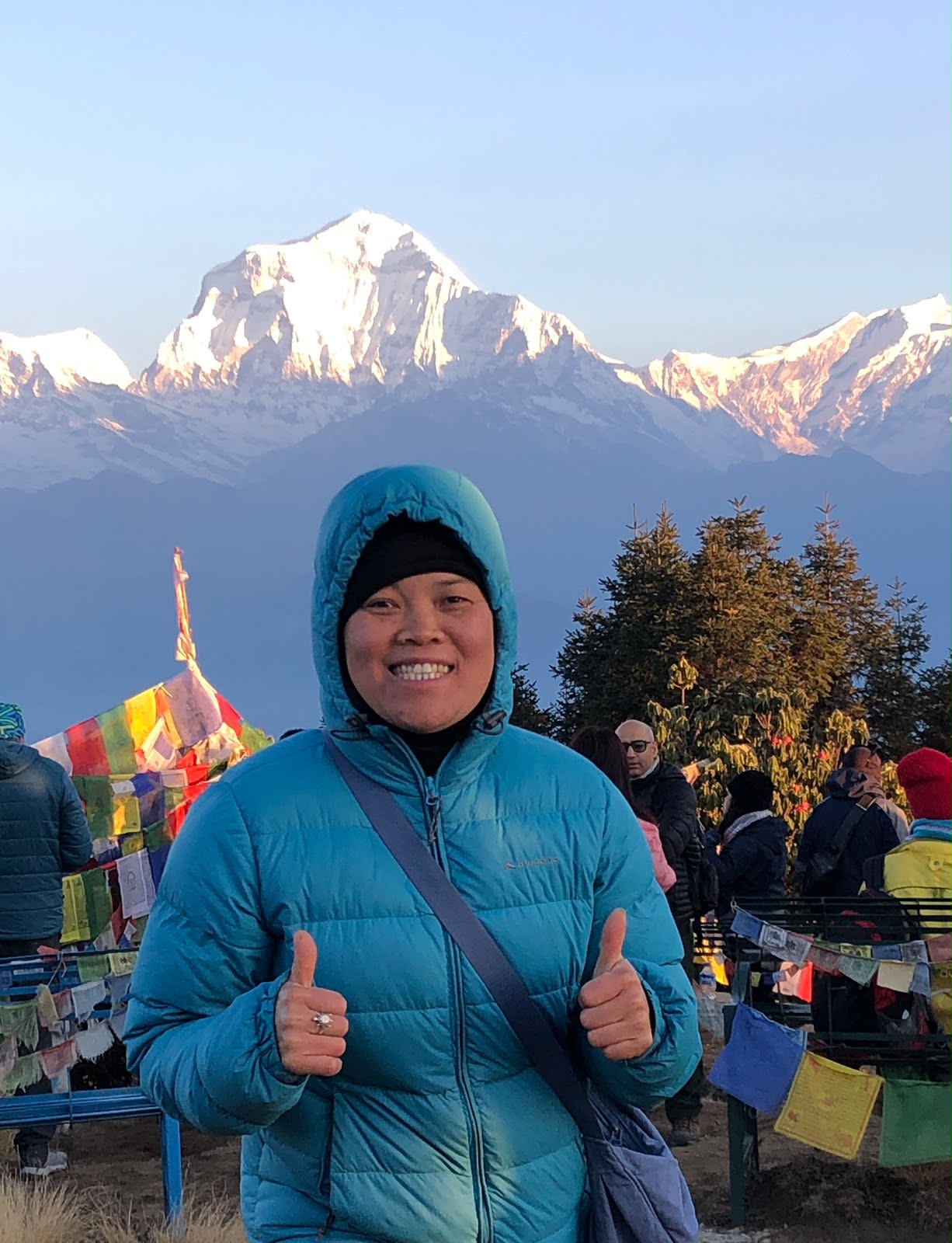
Dhaulagiri I, at 8,167m (26,795ft), lies wholly inside Nepal and is the highest of the three peaks the country owns alone. You do not trek to its base on our routes, but you see it clearly across the valley from the Poon Hill area at dawn. That view, with an eight-thousander catching the first light, is one of the easiest to reach in all of Nepal.
Manaslu, at 8,163m (26,781ft), stands wholly inside Nepal in the Gorkha district, just 4 metres below Dhaulagiri I. The Manaslu Circuit trek loops right around its base, so the mountain stays in view for days at a time. It is a calmer alternative to the Everest and Annapurna trails, with the reward of an eight-thousander overhead for much of the walk.
Annapurna I, at 8,091m (26,545ft), is the lowest of the world's 14 eight-thousanders and sits wholly inside Nepal in the Gandaki region. It closes the head of the Annapurna Sanctuary. The Annapurna Base Camp trek walks right into that ring of peaks and ends almost surrounded by high walls, with Annapurna I standing over the top.
How Everest reached its exact height of 8,848.86m
On 8 December 2020, China and Nepal jointly announced Everest's official height as 8,848.86m. For decades before that, most maps used 8,848m, a figure that came from the 1954 Survey of India. The new measurement added 86 centimetres and, just as important, gave the two countries a single number they both agreed on.
8,848m had been the accepted height since the 1954 Survey of India, and it appeared on maps around the world for decades. On 8 December 2020 that changed, when China and Nepal together set the height at 8,848.86m. The 86-centimetre difference is small, but the agreement behind it mattered more, since it replaced two separate national positions with one shared figure.
8,848.86 metres works out to about 29,032 feet. That thin margin above 8,000m carries real weight for a climber. These are the only mountains on Earth that push into air this thin, which is what sets the 14 eight-thousanders apart from the hundreds of 7,000m peaks around them.
Reading the heights: metres and feet
8,848.86m equals 29,032ft, and every peak on this page is listed both ways on purpose. Nepal and most of the world measure mountains in metres, while many climbers and older maps still work in feet. The two systems can make the same summit sound very different: Everest is either an 8,849m giant or a 29,032ft one. The table above gives both figures so there is no room for confusion.
How trekkers reach these mountains
Everest Base Camp is the most direct way for a walker to stand beneath an eight-thousander. You share the lower trail with climbers bound for the summit, but the trek itself asks for fitness and steady acclimatisation, not technical skill. That is the whole appeal: an ordinary fit person can walk to the base of the highest mountain on Earth.
5,000m is about as high as these treks take you, and getting there safely comes down to pace. You climb only a few hundred metres a day, take rest days to let your body catch up, and drink far more water than feels natural. Done this way, a walk to the base of an eight-thousander is within reach of most fit people, with no ropes, no ice axe and no climbing background.
Four of Nepal's eight-thousanders sit within easy reach of a guided trek: Everest, Annapurna I, Manaslu and Dhaulagiri I. On each of these walks you gain height slowly over many days, which is what keeps a trip toward 5,000m safe for an ordinary fit walker. The mountain is the reward, but the steady pace up to it is what gets you there in one piece.
Which treks put you under an eight-thousander
- Everest, 8,848.86m: the Everest Base Camp trek walks to the base of it.
- Annapurna I, 8,091m: the Annapurna Base Camp trek leads into the Annapurna Sanctuary beneath it.
- Manaslu, 8,163m: the Manaslu Circuit trek loops around the mountain.
- Dhaulagiri I, 8,167m: visible across the valley from the Poon Hill area.
Common questions about Nepal's eight-thousanders
How many eight-thousanders are in Nepal?
Eight of the world's 14 eight-thousanders lie wholly or partly in Nepal: Everest, Kangchenjunga, Lhotse, Makalu, Cho Oyu, Dhaulagiri I, Manaslu and Annapurna I. Three of them, Dhaulagiri I, Manaslu and Annapurna I, sit entirely inside Nepal's borders.
What is the tallest mountain in Nepal?
Everest is the tallest at 8,848.86m (29,032ft), on the border between Nepal and China. That height was jointly announced by the two countries on 8 December 2020, replacing the older 8,848m figure from the 1954 Survey of India.
Which eight-thousanders are entirely inside Nepal?
Three eight-thousanders sit wholly in Nepal: Dhaulagiri I at 8,167m, Manaslu at 8,163m in Gorkha, and Annapurna I at 8,091m in Gandaki. The other five, Everest, Lhotse, Makalu, Cho Oyu and Kangchenjunga, all share a border with China or India.
Can you see an eight-thousander without climbing?
Yes, the Everest Base Camp trek, the Annapurna Base Camp trek and the Manaslu Circuit each bring walkers to the base or into full view of an eight-thousander, with no ropes or climbing skill needed. Dhaulagiri I is even visible from the popular Poon Hill viewpoint.
Why did Everest's height change to 8,848.86m?
On 8 December 2020, Nepal and China published a joint remeasurement that set Everest at 8,848.86m. The earlier 8,848m came from the 1954 Survey of India, and the new survey settled years of small disagreement between the two countries with one shared figure.
Related reading
Dawa Tshering
Trekking Guide, Annapurna Trekking
Dawa Tshering guides treks across Nepal for Annapurna Trekking. More about our team →