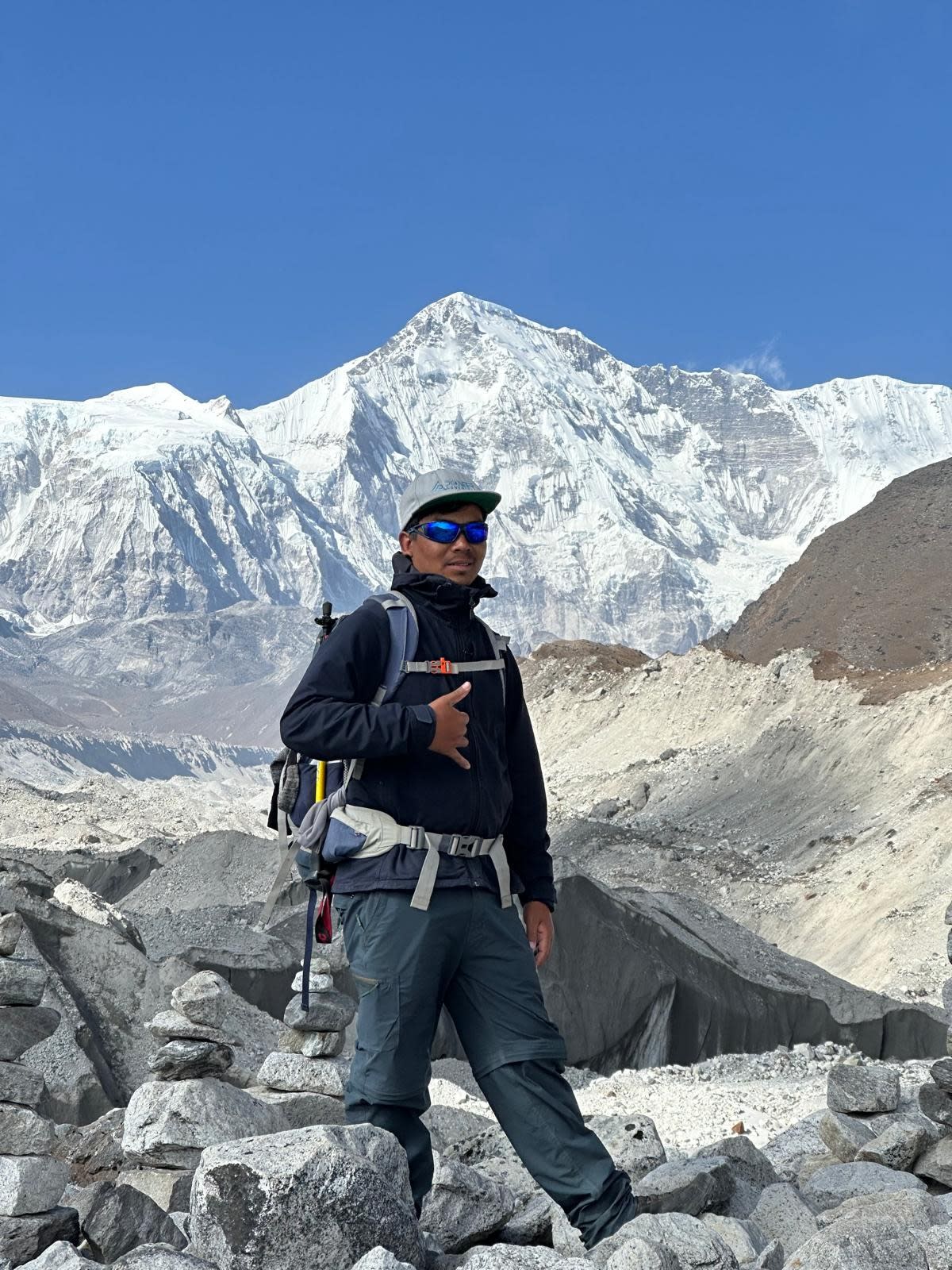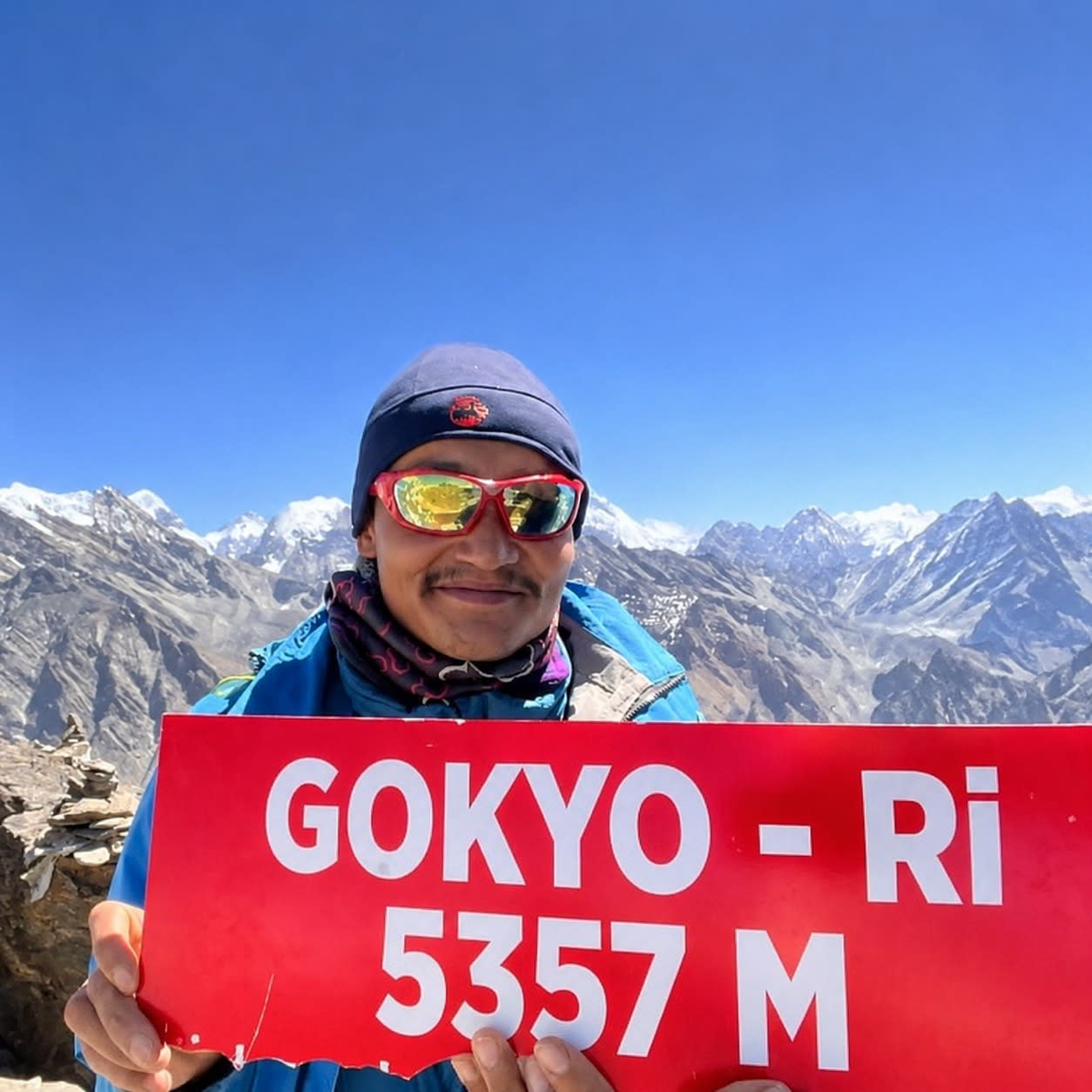

A trekking peak is a smaller Himalayan summit, usually between about 5,500m and 6,584m, that a fit trekker can attempt with a licensed guide on a Nepal Mountaineering Association permit instead of a full expedition royalty. Nepal's popular trekking peaks include Island Peak at 6,189m (20,305ft), Mera Peak at 6,476m (21,247ft) and Lobuche East at 6,119m (20,075ft).
Where trekking turns into climbing
Nepal separates a trek from an expedition, and trekking peaks live right between the two. On a trek you walk to a viewpoint or a base camp and turn back. On a full expedition you take on a big mountain with a large team, a long permit and an expedition royalty that costs far more. Trekking peaks give a strong walker a real summit in the middle, where you strap on crampons for a day or two near the top.
Crampons, a rope and an ice axe are the tools that mark a trekking peak apart from a trek. On most of these summits you use them only for the final stretch, where snow and ice take over from the rough trail. A licensed guide carries the technical gear, fixes the ropes and calls the weather, so a fit walker with no climbing background can still reach the top. That is the whole idea behind an NMA trekking peak: a real Himalayan summit on a simple permit, not an expedition royalty.
Island Peak, also called Imja Tse, shares its whole walk-in with the Everest Base Camp trek. Most people climb it after reaching base camp, because two weeks on the trail is the best possible preparation for the altitude. Before you commit, it helps to know how hard the Everest Base Camp trek is, since the trek is the base the climb is built on. Our guided Island Peak climbing trips follow that same slow, safe build-up.
Nepal's trekking peaks, by height
Chulu East is the highest of the popular NMA trekking peaks at 6,584m (21,601ft), and the rest of the well-known list sits below it. The heights below are the figures most permits and guides use.
6,584m down to about 5,500m is the full spread of these seven peaks, a range of roughly 1,084 metres. Three of them sit close together near the 6,100m mark: Island Peak at 6,189m, Lobuche East at 6,119m and Pisang Peak at 6,091m are all within 98 metres of each other. Yala Peak, at about 5,500m, is the odd one out, low enough that it has dropped off the permit list entirely.
| Peak | Height (m) | Height (ft) | NMA permit |
|---|---|---|---|
| Chulu East | 6,584 | 21,601 | Premium |
| Mera Peak (North) | 6,476 | 21,247 | Standard |
| Chulu West | 6,419 | 21,059 | Standard |
| Island Peak (Imja Tse) | 6,189 | 20,305 | Standard |
| Lobuche East | 6,119 | 20,075 | Standard |
| Pisang Peak | 6,091 | 19,984 | Standard |
| Yala Peak | about 5,500 | about 18,045 | Permit-free |
The seven peaks, one by one
Chulu East, at 6,584m (21,601ft), is the highest of the popular NMA trekking peaks and carries a premium permit rather than the standard one. Being the tallest on the list, it asks for more time and more acclimatisation than the smaller peaks. It suits trekkers who already have high-altitude days behind them and want a bigger objective than a first-timer peak.
Mera Peak, at 6,476m (21,247ft), is the highest of the non-technical trekking peaks and needs a standard NMA permit. Its main North summit is 6,476m, with a Central summit at 6,461m and a South summit at 6,065m. Mera suits a fit trekker who wants a very high summit without technical climbing, though the altitude alone makes it serious. Ignore any listing of 6,654m, which belongs to nearby Peak 41, not to Mera.
Chulu West, at 6,419m (21,059ft), is the third-highest peak on this list and takes a standard NMA permit. It is a high summit climbed with a guide, using crampons on the snow near the top. It suits trekkers who want a 6,400m peak without stepping up to the premium-permit Chulu East beside it.
Island Peak, also called Imja Tse, is 6,189m (20,305ft) and needs a standard NMA permit. Summit day uses fixed ropes and crampons on the steep section near the top, but no prior technical mountaineering experience is required. It pairs with the Everest Base Camp approach, which builds the acclimatisation you need, and it is the peak most first-time Himalayan climbers choose.
Lobuche East, at 6,119m (20,075ft), takes a standard NMA permit and sits just 70 metres above Island Peak in height. It is another guided climb, with crampons and a rope near the summit. It suits a fit trekker looking for a 6,100m peak on a standard permit, either as a first climb or a second one.
Pisang Peak, at 6,091m (19,984ft), is the lowest of the 6,000m peaks here and carries a standard NMA permit. Like the others, it is climbed with a guide, with the technical work saved for the snow near the top. It suits trekkers who want a first 6,000m summit without the height of Mera or the premium fee of Chulu East.
Yala Peak, at about 5,500m (about 18,045ft), is the only peak here that needs no NMA climbing permit at all, because it sits below the NMA's height threshold. To climb it you need Langtang National Park entry, about USD 30, plus a TIMS card. It suits complete beginners after a first taste of Himalayan climbing at the lowest cost, though at 5,500m it still demands fitness and careful acclimatisation.
What a trekking-peak climb actually involves
Even at 6,000m and below, a trekking peak still needs real preparation, though it is not a full expedition. The climb has a few parts that every trip shares, and knowing them helps you pick the right peak and turn up ready.
A licensed climbing guide
One licensed climbing guide is required for a trekking peak, and that guide does the technical work. The guide fixes the ropes, sets the pace, reads the weather and turns the group around if conditions go wrong. On summit day you follow a rope your guide has already fixed, rather than finding your own way up.
Fixed ropes and crampons on summit day
On Island Peak, summit day turns the trek into a climb: the final steep section uses fixed ropes and crampons, though it needs no prior technical experience. You wear a harness, clip into the rope and kick steps up the snow, with your guide managing the safety line above you. Most of the other peaks here follow the same pattern, with the technical work saved for the last stretch.
Days of acclimatisation first
Above 5,000m, acclimatisation is the single biggest factor in reaching any of these summits. The air up there is thin, and your body needs days, not hours, to adjust. This is why Island Peak pairs with the Everest Base Camp trek and why Mera trips build in slow height gain: the walk in is the training, and skipping it makes the summit far more dangerous.
Insurance that covers the height
Many travel insurance policies stop covering you well below 6,000m, which is why insurance is the part people forget. For a trekking peak you need a policy that covers mountaineering and helicopter rescue at the height you will reach. Sort this out before you fly, because you cannot buy it on the trail.
NMA permit fees for 2026
NMA charges a per-person permit fee that changes with the season, and 2026 splits the peaks into standard and premium groups. Spring, the March to May season, is the most expensive. Autumn, winter and summer cost less. On top of the permit, every team pays a refundable garbage deposit of USD 500, which you get back once you carry your rubbish out.
| Category | Example peaks | Spring (USD) | Other seasons (USD) |
|---|---|---|---|
| Standard | Island, Mera, Lobuche East, Pisang, Chulu West | 350 | 175 (autumn/winter/summer) |
| Premium | Chulu East, Singu Chuli | 500 | 250 (autumn) |
| Permit-free | Yala Peak | 0 | 0 |
USD 350 in spring and USD 175 in the other seasons is the standard-peak rate, covering Island, Mera, Lobuche East, Pisang and Chulu West. Premium peaks, which include Chulu East and Singu Chuli, cost USD 500 in spring and USD 250 in autumn. Yala Peak, now off the list, carries no NMA fee at all.
Spring, from March to May, is the busiest climbing season, and the permit costs the most then for every peak. Autumn, the other main trekking season, costs half as much for a standard peak, USD 175 against USD 350, and winter and summer sit at that same lower rate. For a premium peak like Chulu East, the autumn fee of USD 250 is half the USD 500 spring price. If your dates can move, an autumn climb saves real money on the permit alone.
USD 250 is an older, lower spring rate that still floats around on many websites, so treat any cheap quote with care. Fees change, and the NMA updates them between years. Always confirm the current permit fee with the Nepal Mountaineering Association, or ask us to check it, before you lock in a trip.
Common questions about Nepal's trekking peaks
What is a trekking peak in Nepal?
A trekking peak is a smaller Himalayan summit that a fit trekker can climb with a licensed guide on a Nepal Mountaineering Association permit, rather than the full royalty an expedition peak needs. Popular examples run from Yala Peak at about 5,500m up to Chulu East at 6,584m.
What is the highest trekking peak in Nepal?
Chulu East, at 6,584m, is the highest of the popular NMA trekking peaks. Mera Peak, at 6,476m, is often called the highest, but that is only true for the easy, non-technical peaks, since Chulu East stands higher.
How high is Mera Peak?
Mera Peak's main North summit is 6,476m (21,247ft), with a Central summit at 6,461m and a South summit at 6,065m. The figure of 6,654m sometimes linked to Mera is wrong and actually belongs to nearby Peak 41.
Do you need experience to climb Island Peak?
No prior technical mountaineering experience is required for Island Peak, though summit day uses fixed ropes and crampons on the steep upper section. Good fitness and a solid acclimatisation, usually from the Everest Base Camp approach, matter far more than past climbing.
How much is an NMA trekking peak permit in 2026?
Standard peaks such as Island and Mera cost USD 350 per person in spring and USD 175 in autumn, winter and summer, while premium peaks like Chulu East cost USD 500 in spring and USD 250 in autumn, plus a refundable USD 500 garbage deposit per team. An older USD 250 spring rate still circulates, so confirm the current fee with the NMA before booking.
Related reading
Dawa Tshering
Trekking Guide, Annapurna Trekking
Dawa Tshering guides treks across Nepal for Annapurna Trekking. More about our team →