The Langtang Valley Trek is a moderate 9-day out-and-back route through Langtang National Park, running from Syabrubesi (1,550m) to Kyanjin Gompa (3,870m) beneath the Langtang Lirung massif (7,227m). Guided packages start around USD 690 to USD 1,090 per person in 2026 depending on group size, and the trailhead sits roughly 125 kilometres north of Kathmandu, a 7 to 8-hour drive that needs no domestic flight. The standard itinerary tops out at Kyanjin Ri (4,773m), a viewpoint reached on a single acclimatisation day hike from Kyanjin Gompa.
Two permits cover the route in 2026: a Langtang National Park entry fee of NPR 3,000 and a TIMS card, both checked at the Dhunche checkpoint on the drive north. The valley carries a harder history than its neighbours. A landslide triggered by the April 2015 earthquake buried most of Langtang Village, and the trail only reopened to trekkers in 2017 once the community had rebuilt on higher ground. Every group that walks through today passes directly through that rebuilt village.
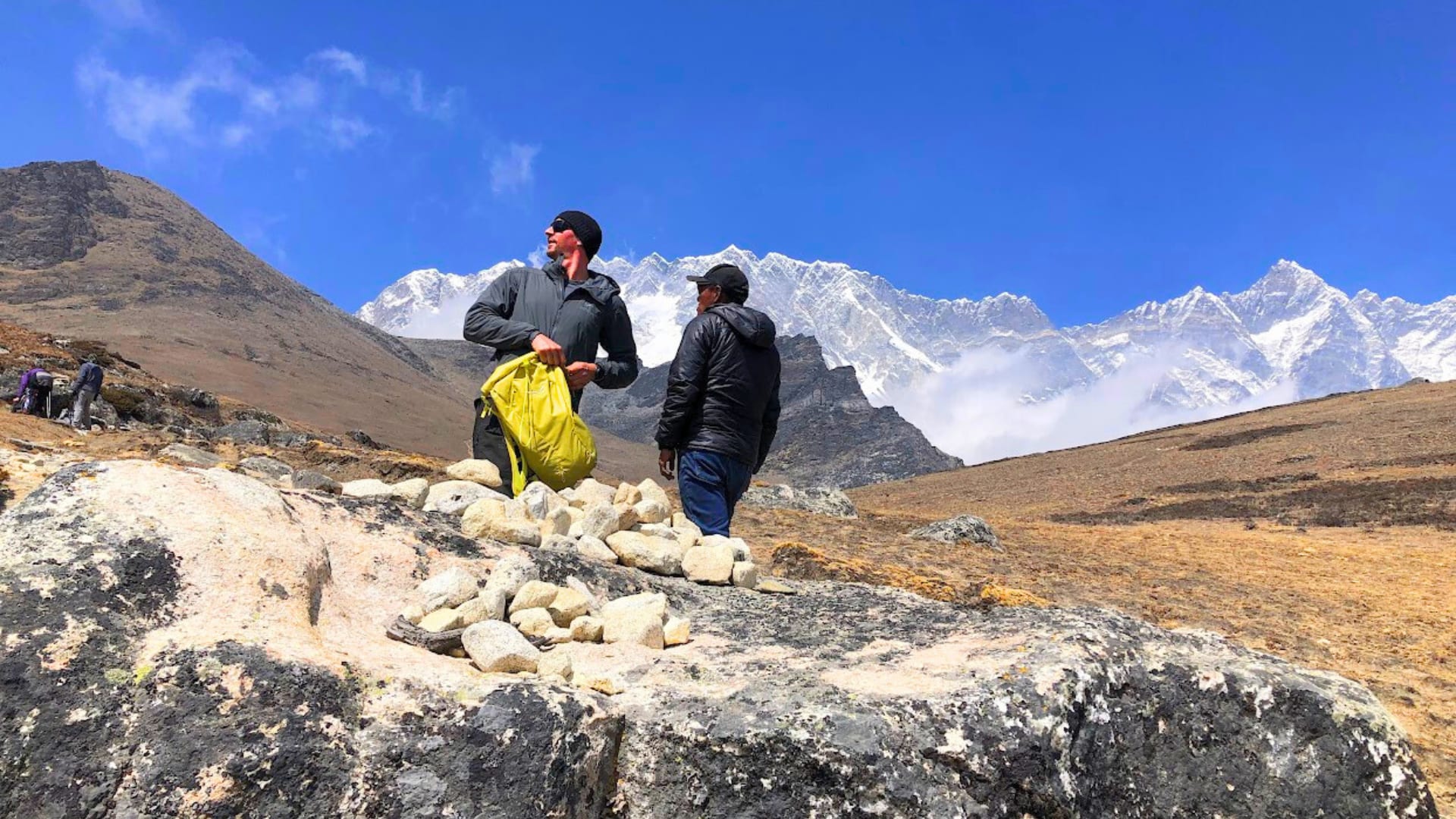
What makes Langtang different from Everest Base Camp or the Annapurna Circuit?
Distance from Kathmandu is the first difference. Everest Base Camp depends on a Lukla flight that costs USD 180 or more each way and cancels routinely in poor weather, while the Langtang Valley Trek starts with a single overland drive, so a trekker can be walking the day after landing in Nepal. The Annapurna Circuit and Annapurna Base Camp both require a longer road transfer to Pokhara first, adding a full extra travel day each way compared to Langtang's direct route north from Kathmandu.
Traffic on the trail is the second difference, though the gap has narrowed in recent years. Everest Base Camp still draws more than 40,000 trekkers a year through the single Lukla to Namche corridor, and the Annapurna Circuit alone logged over 246,000 visitors in the first ten months of 2025. Langtang and its Gosaikunda extension recorded a little over 42,000 domestic and international visitors in the first eleven months of the 2024/25 fiscal year, enough to rank third nationally but still a fraction of Annapurna's volume and spread across a valley with far fewer route branches than the Khumbu or the Annapurna circuits. Tea houses in Langtang remain small and family-run rather than the multi-storey lodges now common in Namche or Manang.
Altitude is the third difference. Kyanjin Ri sits about 590 metres lower than Everest Base Camp (5,364m) and 640 metres lower than Thorong La on the Annapurna Circuit (5,416m), which makes Langtang a realistic first high-altitude trek for someone who wants genuine mountain scenery without the physiological demands of the two higher routes.
The route from Syabrubesi to Kyanjin Gompa
Syabrubesi (1,550m) sits at the confluence of the Langtang Khola and the Bhote Koshi, a Tamang village that marks the start and end of the standard trek. From here the trail follows the Langtang Khola upstream for roughly 30 kilometres to Kyanjin Gompa, gaining just over 2,300 metres of sleeping altitude across three trekking days before the final push to Kyanjin Ri.
Syabrubesi to Lama Hotel: forest and river gorge
The first stage covers roughly 11 kilometres, climbing through subtropical forest, bamboo groves, and rhododendron-oak woodland to Lama Hotel (2,480m), a cluster of lodges rather than an actual town. Langur monkeys and pheasant are common through this stretch, and red panda occasionally show in the understory, though sightings are rare.
Langtang Village: the rebuilt heart of the valley
Above Lama Hotel's 2,480m, the forest thins into alpine meadow, and Langtang Lirung (7,227m) becomes visible for the first time. Langtang Village (3,430m) sits where the original settlement stood before 2015; the rebuilt village now stands on the same valley floor, a short distance from the old site, with new lodges, a school, and a monastery serving the families who returned.
Kyanjin Gompa: monastery, cheese factory, glacier
Kyanjin Gompa (3,870m) is the trek's high point for accommodation, a small cluster of tea houses enclosed on three sides by peaks above 6,000m. The 400-year-old monastery that gives the settlement its name sits alongside a cheese factory dating to 1955, when Swiss dairy expert Werner Schulthess helped establish Nepal's first commercial cheese production using local yak and nak milk. Both the gompa and the cheese factory were damaged in 2015 and have since been rebuilt.
Day-by-day itinerary
The table below follows the standard 9-day Langtang Valley Trek itinerary that Annapurna Trekking runs in 2026, Kathmandu to Kathmandu.
| Day | Route | Altitude | Walking time |
|---|---|---|---|
| 1 | Arrive Kathmandu | 1,400m | - |
| 2 | Drive to Syabrubesi | 1,550m | 7-8 hrs drive |
| 3 | Syabrubesi to Lama Hotel | 2,480m | 6 hrs |
| 4 | Lama Hotel to Langtang Village | 3,430m | 5 hrs |
| 5 | Langtang Village to Kyanjin Gompa | 3,870m | 4 hrs |
| 6 | Kyanjin Ri day hike | 4,773m | 5 hrs |
| 7 | Kyanjin Gompa to Lama Hotel | 2,480m | 6 hrs |
| 8 | Lama Hotel to Syabrubesi, drive to Kathmandu | 1,400m | 5 hrs walk + drive |
| 9 | Kathmandu departure | 1,400m | - |
Days 3 to 7 do the actual trekking; days 1, 2, 8, and 9 are travel and buffer. Trekkers with more time routinely extend the itinerary by two days to add the Tserko Ri viewpoint or continue over the Laurebina Pass to the Gosaikunda lakes (4,380m).
The 2015 earthquake and Langtang Village today
On 25 April 2015, the magnitude 7.8 Gorkha earthquake triggered a landslide and air blast above Langtang Village that buried most of the settlement within minutes. Government figures put the official death toll at 306: roughly 175 of the estimated 370 residents present that day, 82 Nepalis from elsewhere in the country, and 49 foreign trekkers and climbers. Survivors and villagers who lived through it have long maintained the real number was closer to 500, a discrepancy a ten-year retrospective published by Al Jazeera in April 2025 documented in detail.
Recovery took roughly two years. The Tamang families who survived, many away from the village or working in the fields when the slide hit, rebuilt on a new site slightly above the buried original, with support from international non-profits and Swiss development partners who already had long-standing ties to the valley through the cheese factory. The trail reopened to trekkers in 2017, and Langtang Village today has a school, a health post, guesthouses, and a monastery, all built after the disaster.
Every standard Langtang itinerary, including Annapurna Trekking's 9-day route, passes directly through the village on day 4 en route to Kyanjin Gompa. Lodge owners there are, in most cases, the same families or their children who returned after 2015. Spending a night in the village and eating at a family-run tea house puts trekking income directly into the community that rebuilt it.
Permits: Langtang National Park fee and TIMS in 2026
Two documents are mandatory for every foreign trekker in the valley: the Langtang National Park entry permit at NPR 3,000 (NPR 1,500 for SAARC nationals) and a TIMS card, both checked at the Dhunche checkpoint on the drive north from Kathmandu. One park ticket covers the entire protected area, so a single fee serves the standard Kyanjin Gompa route as well as extensions over the Laurebina Pass to Gosaikunda and on to Helambu.
| Permit | Cost | Checked at |
|---|---|---|
| Langtang National Park entry | NPR 3,000 (NPR 1,500 SAARC) | Dhunche |
| TIMS, Blue (agency-booked) | NPR 1,000 | Dhunche / Syabrubesi |
| TIMS, Green (independent) | NPR 2,000 | Dhunche / Syabrubesi |
TIMS in Langtang comes in two tiers, mirroring the system used across Annapurna: a Blue card at NPR 1,000 for trekkers booked through a registered agency, and a Green card at NPR 2,000 for independent applicants, who still need a licensed guide under the rule Nepal introduced in April 2023. Enforcement is the detail worth knowing before you go. Where Everest and Annapurna checkpoints have grown inconsistent about checking TIMS at some posts, Langtang has not relaxed: Dhunche and Syabrubesi check every group's card, now logged as a digital e-TIMS record rather than a paper slip. Our Nepal trekking permits guide covers the fee schedule for every region if your trip combines Langtang with another valley.
Altitude and acclimatisation on the standard itinerary
The steepest single-day gain on the standard itinerary is 950 metres, from Lama Hotel (2,480m) to Langtang Village (3,430m) on day 4, still below the 3,000m mark where acclimatisation risk rises sharply. Above that threshold, the profile flattens: day 5 from Langtang Village to Kyanjin Gompa (3,870m) gains a controlled 440 metres over a short 4-hour, 7-kilometre stage, built in deliberately to bank rest before the push to Kyanjin Ri (4,773m) the following day.
Mild acute mountain sickness is possible at Kyanjin Gompa and on the Kyanjin Ri hike, though it is less common here than on treks that push above 5,000m for multiple nights. Guides carry a pulse oximeter and check oxygen saturation at Kyanjin Gompa; the standard response to a moderate headache or nausea is to rest at altitude rather than continue climbing, and to descend if symptoms do not ease within a day. Our altitude sickness prevention guide covers the full AMS, HACE, and HAPE symptom list and what to do at each stage, relevant on Langtang even though its altitude ceiling sits below Everest or Annapurna's high passes.
Kyanjin Ri and Tserko Ri: the valley's two viewpoint hikes
Two day hikes climb above Kyanjin Gompa, and most trekkers only have time or acclimatisation for one. Kyanjin Ri is the standard choice on Annapurna Trekking's 9-day itinerary; Tserko Ri is the higher, harder alternative for groups with an extra day built in.
Kyanjin Ri (4,773m)
Kyanjin Ri gains roughly 900 metres from Kyanjin Gompa over a steep but short trail, a 4 to 5-hour round trip that most trekkers complete before midday. The summit delivers a 360-degree panorama across Langtang Lirung (7,227m), Gangchenpo (6,387m), Naya Kanga (5,844m), and Dorje Lakpa (6,966m), with the Tibet border visible on clear mornings. A lower shoulder at roughly 4,300m offers a similar view for trekkers who prefer not to push to the true summit.
Tserko Ri (5,033m), the harder alternative
Tserko Ri sits 260 metres higher than Kyanjin Ri and demands closer to 1,500 metres of cumulative ascent from Kyanjin Gompa, a route most operators quote at 6 to 8 hours round trip. The reward is the highest point reached anywhere on the Langtang Valley Trek and a wider view that includes Shishapangma (8,027m) across the Tibetan border. Guides recommend Tserko Ri only for trekkers who felt strong on the approach to Kyanjin Gompa and are willing to add a day to the standard 9-day plan.
What the Langtang Valley Trek costs in 2026
Annapurna Trekking runs the 9-day guided package from USD 690 to USD 1,090 per person in 2026, scaled by group size, with permits, guide, porter, all meals and tea house accommodation, and Kathmandu to Syabrubesi transport included.
| Group size | Price per person |
|---|---|
| Solo private | USD 1,090 |
| Small private (2-3) | USD 850 |
| Standard group (4-7) | USD 750 |
| Large group (8-12) | USD 690 |
Independent budgets run lower on paper, typically USD 700 to USD 900 for a self-organised 9 to 10-day trip, but the 2023 guide mandate means a licensed guide is a fixed cost either way, at USD 25 to USD 35 a day. That narrows the real gap between package and independent pricing to transport logistics and the convenience of not booking tea houses yourself in peak season. Excluded from every package: Nepal visa fees, travel insurance with helicopter evacuation cover, and tips for guide and porter, typically USD 80 to USD 120 total for a trek this length.
Best months to trek Langtang
October and April are the two strongest months, both rated "best" in Annapurna Trekking's seasonal data for the route, with daytime highs of 12 to 14°C at Syabrubesi and low precipitation through the trekking window. March, May, September, and November all rate "good," while June through August bring the monsoon's heaviest rain to the lower forest sections between Syabrubesi and Lama Hotel.
December is workable but cold, with night lows at Kyanjin Gompa dropping toward -8°C to -10°C, and most operators, including ours, mark it a lower-recommendation month rather than ruling it out entirely. January and February sit outside the standard departure calendar for this itinerary.
Who Langtang suits, and who should look elsewhere
Annapurna Trekking rates the Langtang Valley Trek 5 out of 10 on our internal fitness scale, lower than Everest Base Camp or the Annapurna Circuit, and suitable for trekkers aged roughly 12 to 72 with no prior high-altitude experience required. Families travelling with teenagers and first-time Himalayan trekkers who want mountain scenery without a multi-week commitment are the two groups who benefit most from this route.
Two groups should look elsewhere. Trekkers who specifically want to reach 5,000m or higher will find Kyanjin Ri's 4,773m a hard ceiling on the standard itinerary, though adding Tserko Ri closes some of that gap. Trekkers travelling in July or August should also reconsider, since the forest sections below Kyanjin Gompa see the heaviest monsoon rainfall of any month on the route.
Plan your Langtang Valley Trek
Annapurna Trekking runs the Langtang Valley Trek year-round in private and small group departures, with permits, guide, porter, and all tea house logistics handled before you land in Kathmandu. See the Langtang Valley Trek page for the full day-by-day itinerary and 2026 group pricing, or contact us to check dates for your preferred month.
Frequently asked questions
How many days is the Langtang Valley trek?
The Langtang Valley trek runs about 9 days, reaching Kyanjin Ri at 4,773 metres. The trailhead at Syabrubesi is a 7 to 8 hour drive from Kathmandu, with no flight needed.
How hard is the Langtang Valley trek?
It is rated moderate, with a gradual climb to under 4,800 metres and comfortable teahouses. It suits fit beginners who want a real Himalayan trek without a domestic flight.
What permits do you need for Langtang?
You need the Langtang National Park entry permit (NPR 3,000) and a TIMS card, both arranged by your agency. A licensed guide is required under the 2023 rule.
Related guides

Founder & Lead Guide, Annapurna Trekking
AJ founded Annapurna Trekking in 2016 and has personally guided treks across Nepal ever since. More about our team →