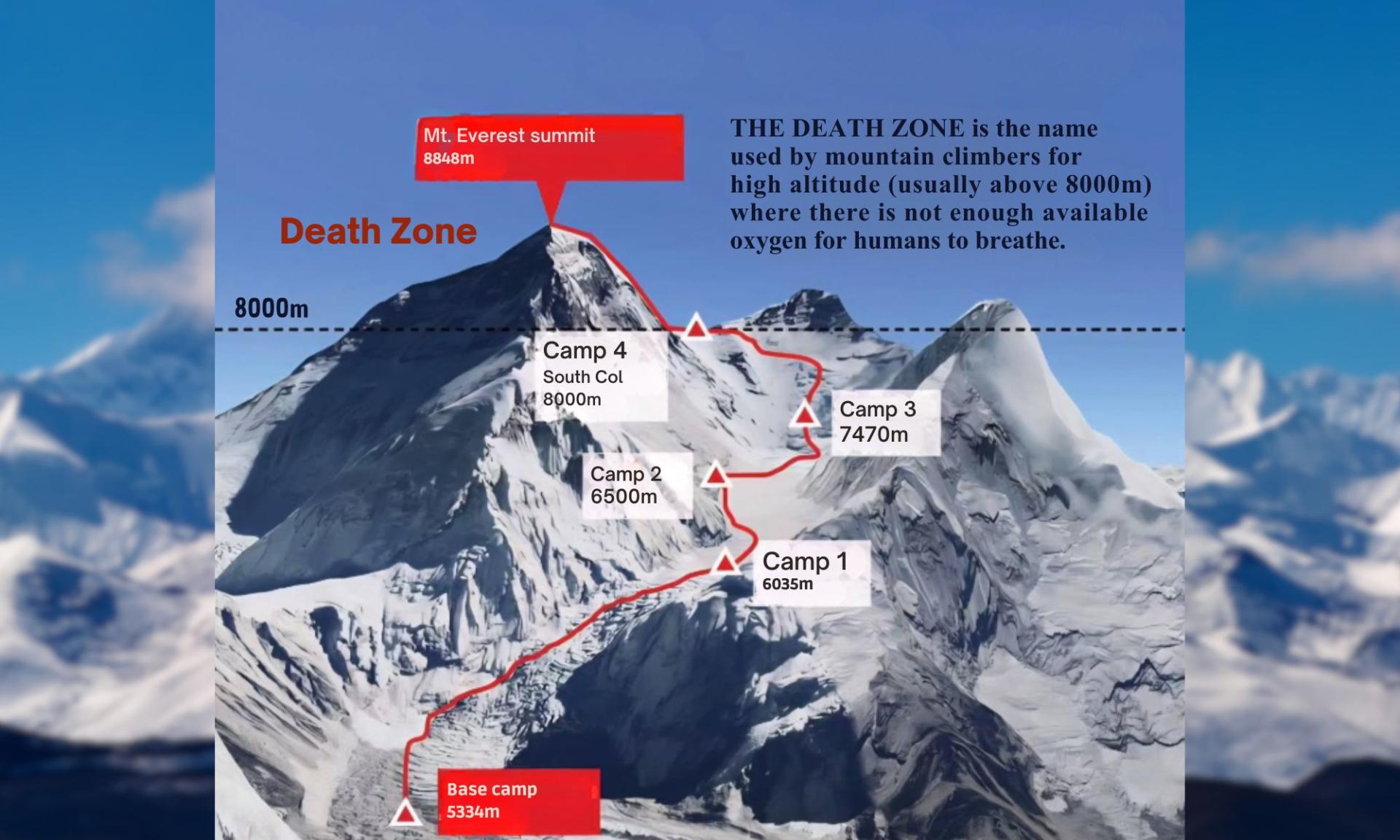
The death zone is the altitude above about 8,000 metres (26,000 feet), where the air pressure is so low that the human body cannot survive for long. The death zone is a mountaineering term, not a trekking one: it names the height on the world's tallest peaks where there is too little oxygen to sustain life, even for an acclimatised climber. Here is the reassuring part for trekkers. You will never go near it on a normal Himalayan trek, and the popular routes in Nepal top out thousands of metres below it.

Why trekkers never enter the death zone
The Everest Base Camp trek reaches 5,364 metres at base camp and 5,545 metres at Kala Patthar, its highest point. Both sit more than 2,400 metres below the 8,000-metre death zone. That gap is enormous in altitude terms, and it is the difference between a hard but safe walk and a genuine fight for survival. Trekkers acclimatise slowly, sleep low, and climb high only for short viewpoints, which keeps them in a range the body can handle.
Nepal's trekking routes are built to stay far below the death zone. No teahouse trek in the country sends you anywhere near 8,000 metres, and the highest points on the popular routes sit around 5,400 to 5,600 metres. If you want a clear sense of the effort involved without the danger of extreme altitude, our guide to how hard the Everest Base Camp trek is breaks it down honestly, and the slow-ascent habits in our guide to preventing altitude sickness on a Nepal trek are what keep the walk safe. To see the Khumbu for yourself, the Everest Base Camp trek is the classic route.
Kala Patthar, at 5,545 metres, is the single highest point most Everest trekkers ever stand on. From there you look up at the summit of Everest, still more than 3,300 metres higher and deep inside the death zone. That view is the closest a trekker ever comes to it, and it is close enough. You see the death zone from a distance; you do not step into it.
Why the air runs out up high
The air is about 20.9 percent oxygen at every altitude, from the beach to the summit of Everest. That surprises people, because it feels like there is simply "less oxygen" up high. What actually changes is the air pressure. As you climb, the barometric pressure drops, and with it the partial pressure of oxygen, which is the push that drives oxygen from your lungs into your blood.
A firm push moves oxygen into your blood at sea level, where the pressure is about 1,013 millibars. At 8,000 metres that push drops to roughly a third, so even though every breath still holds 20.9 percent oxygen, far less of it actually crosses into your bloodstream. Your lungs work just as hard, but the thin air does not help the way it does at home. That falling pressure, not any change in the oxygen itself, is the whole problem.
At sea level the pressure is about 1,013 millibars, or 760 millimetres of mercury. At 8,000 metres it falls to roughly 356 millibars, about 267 millimetres of mercury, which is close to a third of the sea-level value. On the summit of Everest at 8,849 metres, the partial pressure of oxygen is less than a third of what it is at sea level. Same percentage of oxygen in the air, far less pressure to move it into your bloodstream.
At sea level, a healthy person's blood oxygen saturation reads 95 to 100 percent, meaning the blood is almost fully loaded with oxygen. High in the death zone that figure can fall toward 50 to 60 percent, a reading that would put someone in a hospital bed back home. This is why climbers move slowly up there and why many rely on bottled oxygen. Their blood is barely half charged.
Three altitudes show how fast the air thins as you climb. Sea level, the top of the death zone, and the summit of Everest sit far apart on every measure that matters, while the air's oxygen percentage stays the same throughout. The table uses round figures.
Location | Altitude | Air pressure | Oxygen in air |
|---|---|---|---|
Sea level | 0 m | ~1,013 mb (760 mmHg) | 20.9% |
Everest Base Camp (trek) | 5,364 m | about half of sea level | 20.9% |
Death zone begins | ~8,000 m | ~356 mb (267 mmHg) | 20.9% |
Everest summit | 8,849 m | less than a third of sea level | 20.9% |

What the death zone does to the body
Above 8,000 meters, the body cannot acclimatize at all. Lower down, given enough days, the body slowly adjusts to thin air. In the death zone there is no adjusting: the body uses oxygen faster than it can be replaced, so it begins to shut down no matter how fit or experienced the climber is. Every hour spent there is a withdrawal from a battery that cannot recharge.
Acclimatization, the body's slow fix for thin air, works well up to roughly 5,500 meters. Given enough days, a trekker makes small adjustments that let them function and feel reasonably normal at those heights. Above 8,000 metres that process stops entirely, because the body cannot keep pace with how fast it is losing oxygen. The death zone is, in effect, the altitude where acclimatisation runs out of road.
Within hours, the effects build and feed on each other. Body functions slow, thinking gets cloudy, and judgment fails, which is dangerous on terrain that demands clear decisions. The risk of fluid building up on the lungs or the brain climbs sharply, and either one can kill. Beyond that lie unconsciousness and death, which is exactly why the zone earned its blunt name.
In the death zone, the failures tend to stack up fast:
Body functions slow as the cells are starved of oxygen.
Thinking clouds over and judgment fails on dangerous ground.
Fluid can build up on the lungs or on the brain.
Unconsciousness and death follow if the climber does not get down.
A climber can last anywhere from a few hours to a couple of days in the death zone, and no single rule fits everyone. It depends on the person, the weather, and whether they carry bottled oxygen. There is no exact clock that starts ticking the moment you cross 8,000 metres. The safe move is always to get up, down, and out as fast as conditions allow.
Compare that with acclimatised trekking well below 6,000 metres, and the difference is night and day. On a trek your body has days to adjust, you sleep lower than you climb, and your blood oxygen, though lower than at home, stays high enough to keep you thinking clearly. The death zone strips away every one of those safety margins at once. That is why mountaineering above 8,000 metres and walking to a 5,545-metre viewpoint are simply not the same activity.
Where the death zone actually is
There are 14 mountains on Earth that rise above 8,000 metres, and every one of them stands in the Himalaya or the Karakoram. These are the only places on the planet with a death zone, because no other mountain range reaches that high. Climbing all 14 is one of mountaineering's ultimate challenges, and it is a world away from trekking. Nepal is home to several of these giants, including Everest.
Everest, at 8,849 metres, is the highest of the 14 and the most famous death-zone peak. The other thirteen 8,000-metre giants each carry their own thin-air ceiling, spread across the Himalaya and the Karakoram. For a trekker, these summits are scenery, not destinations: you photograph them from a ridge or a base camp and turn around. The mountaineers who climb them train for years and usually rely on Sherpa teams, bottled oxygen, and narrow weather windows.
Do trekkers go into the death zone?
No. Trekkers never enter the death zone, because it begins at about 8,000 metres and the highest trekking points in Nepal sit around 5,400 to 5,600 metres. The Everest Base Camp trek tops out at 5,545 metres on Kala Patthar, more than 2,400 metres under the death zone.
How high is the death zone?
The death zone starts at about 8,000 metres, or 26,000 feet. Above that height the air pressure is too low for the body to survive for long, even with acclimatisation. Only 14 mountains on Earth reach into it, all in the Himalaya and Karakoram.
Is there less oxygen in the air in the death zone?
The air is still about 20.9 percent oxygen in the death zone, the same as at sea level. What changes is the air pressure, which at 8,000 metres is roughly a third of the sea-level value, so far less oxygen is pushed from your lungs into your blood.
Why can't the body acclimatise in the death zone?
Above 8,000 metres the body uses oxygen faster than it can take it in, so there is nothing for it to adjust to. Lower down the body adapts over days, but in the death zone it only deteriorates. Blood oxygen saturation can fall toward 50 to 60 percent, and breathing, judgment, and consciousness all suffer.
How long can a person survive in the death zone?
Time in the death zone is limited and varies, running from a few hours to a couple of days depending on the climber, the weather, and bottled oxygen. There is no fixed limit. The longer anyone stays above 8,000 metres, the higher the chance of fluid on the lungs or brain, unconsciousness, or death.
Related reading
Pemba Sherpa
Trekking Guide, Annapurna Trekking
Pemba Sherpa guides treks across Nepal for Annapurna Trekking. More about our team →