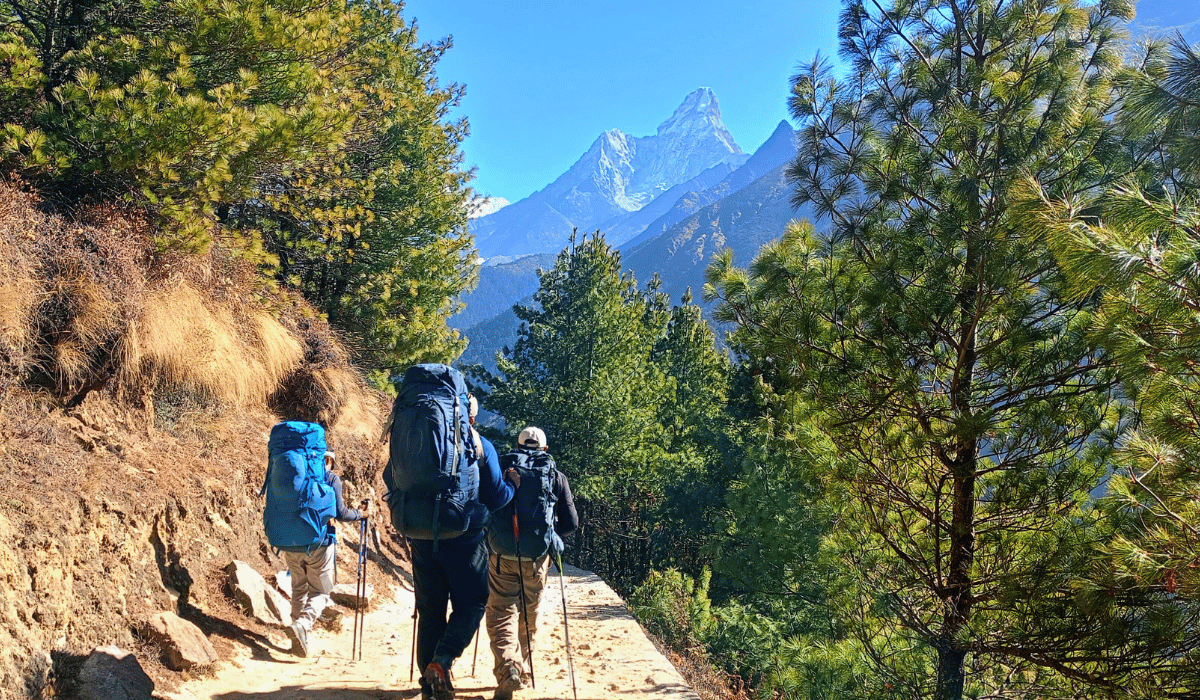
Train four to five days a week for 12 weeks, and build up to two long hill walks on back-to-back days: about 6 to 7 hours, then about 5 hours, with a 5 to 7 kg pack. That matches the Everest Base Camp trek, which ends with four 7-hour days in a row. Fitness makes those days easier, but it does not lower your risk of altitude sickness.
What does the Everest Base Camp trek ask of your body?
The Everest Base Camp trek covers about 130 kilometres, and it is walking, not climbing. No ropes are needed. So your training should look like walking too: long, slow hours on hills, day after day.
Look at the walking hours on our Everest Base Camp trek and the pattern is clear.
| Itinerary day | Walk | Hours |
|---|---|---|
| 1 | Lukla to Phakding | 3 |
| 2 | Phakding to Namche Bazaar | 5 |
| 3 | Rest day at Namche | Rest |
| 4 and 5 | Namche to Tengboche to Dingboche | 5 each |
| 6 | Rest day at Dingboche | Rest |
| 7 | Dingboche to Lobuche | 4 |
| 8 | Lobuche to Base Camp, then Gorak Shep | 7 |
| 9 | Kala Patthar, then down to Pheriche | 7 |
| 10 | Pheriche to Namche Bazaar | 7 |
| 11 | Namche to Lukla | 7 |
Most plans focus on getting you up. Yet the longest stretch comes at the end, when you are tired and short of sleep. Day 9 alone starts at 5,545 metres and finishes at 4,280 metres. That is about 1,265 metres of height lost, and your thighs and knees do the braking. So this plan trains for repeated long days and for going downhill. For the wider picture, read how hard the Everest Base Camp trek is.
Can you start this plan?
You are ready for week 1 if you can walk briskly for 30 minutes without stopping. If you cannot, spend four to six weeks reaching that point first. Give yourself more time before you try to do more each week.
See a doctor before you book. A 2026 BMJ practice article says people should ideally get advice before booking high-altitude travel. A study of 350 trekkers on this route found 12% had an existing heart or circulation condition. Its authors still called high trekking generally safe, but they want every trekker checked first.
The 12-week plan
The weekly base follows the NHS adult guidance of at least 150 minutes of moderate activity plus strength work on two days. The long walk is what makes it a trekking plan. Do it on hills if you can.
| Week | On weekdays | Weekend walk | Pack |
|---|---|---|---|
| 1 | 3 brisk walks of 30 min, 2 strength | 2 hours | None |
| 2 | 3 brisk walks of 40 min, 2 strength | 2.5 hours | None |
| 3 | 3 brisk walks of 45 min, 2 strength | 3 hours | 3 kg |
| 4 (easy) | 2 walks of 30 min, 1 strength | 2 hours | 3 kg |
| 5 | 2 hill walks of 45 min, 1 stairs session, 2 strength | 4 hours | 5 kg |
| 6 | 2 hill walks of 50 min, 1 stairs session, 2 strength | 4.5 hours | 5 kg |
| 7 | 2 hill walks of 60 min, 1 stairs session, 2 strength | 5 hours, with long descents | 5 to 6 kg |
| 8 (easy) | 2 walks of 30 min, 1 strength | 3 hours | 5 kg |
| 9 | 2 hill walks of 60 min, 2 strength | Saturday 5 hours, Sunday 3 hours | 6 kg |
| 10 | 2 hill walks of 60 min, 2 strength | Saturday 5.5 hours, Sunday 4 hours | 6 to 7 kg |
| 11 (peak) | 2 walks of 45 min, 1 strength | Saturday 6 to 7 hours, Sunday 5 hours | 6 to 7 kg |
| 12 (taper) | 2 walks of 30 min, light stretching | 2 hours, with a short downhill section | Light |
Pack weights assume a porter carries your main bag, as on our trips, so you carry water, layers and a camera. If you plan to carry more on the trail, train with what you will really carry.
Easy weeks are part of the plan. Do not fill them with extra sessions. If you miss a week through illness, repeat the last week you finished. Do not double up to catch up.

Which strength exercises help most?
Two short sessions of 20 to 30 minutes are enough. The NHS advises working the main muscle groups, including legs, hips, back and core, until you need a short rest. These five cover what the trail asks for.
- Step-ups. Use a stair or a sturdy box, and add your pack as you get stronger.
- Slow step-downs. Lower yourself off a step over about three seconds. This trains the muscles that brake on descents.
- Squats or sit-to-stands. Start with a chair behind you.
- Calf raises. Do them on a step, as stone stairs are hard on the lower leg.
- Side planks and bird dogs. A steady trunk helps you carry a pack for hours.
Why does downhill training matter?
Downhill walking loads muscles as they lengthen, and that causes soreness in people who are not used to it. Your body adapts quickly, though. In a 2017 study of 36 untrained young men, those who walked downhill for only five minutes a week before a 40-minute downhill walk had far less soreness: about 28 on a 100-point scale, against 81 for those who did nothing.
That was a short treadmill test, not a Himalayan trek, so the numbers will not transfer directly. Even so, the idea is cheap to use. Do not save descents for your final weeks, and keep a short downhill section in week 12. No hills near you? Walk down stairs in a tall building and take the lift up, or use the descent setting on a gym treadmill if it has one.

What can training not do?
Training does not protect you from altitude illness. The CDC Yellow Book says plainly: "Training and physical fitness do not affect risk." The BMJ article goes further. It says fit, younger travellers may be at more risk because they often climb faster and take fewer rest days.
Altitude sickness is common on this route even with rest days. A study of 332 volunteers trekking to Base Camp recorded it in 73.5% of them, using a broad scoring system. In that study, age, weight and earlier altitude sickness did not predict who got it. People who had been above 5,000 metres before had lower rates. Other studies report lower numbers, so the figure depends on how it is measured. The message stays the same: strong legs do not excuse you from the plan.
So use your fitness to walk slowly and comfortably. If you finish each day with energy left, your training worked. It does not mean you can skip a rest day. Our altitude sickness prevention guide covers warning signs and medicine.
Should you use an altitude tent or mask?
Our advice is to save your money unless your doctor has a specific reason. The BMJ authors say "evidence to support pre-acclimatisation is lacking" for repeated low-altitude hypoxia. The CDC separately says that spending two to three nights at about 2,450 to 2,750 metres is markedly protective, so real time at moderate altitude is a different matter. Sources do not fully agree here, and few people can arrange those nights anyway. A training mask does not create the same conditions.
How do you get your kit ready?
- Weeks 1 to 4. Buy your boots and wear them on every long walk. New boots on day one of a trek are a common way to start with blisters.
- Weeks 5 to 8. Test your socks, pack straps, poles and water system. Our Nepal trekking packing list has the full list.
- Weeks 9 to 11. Walk in cold, wet or windy weather at least once, wearing your real layers. Practise changing a layer with cold hands.
- Week 12. Rest. Walk gently, sleep well, and avoid anything new. A strain from a last hard session is worse than losing a little fitness.
How do you know you are ready?
Use weekend 11 as your test. You are in good shape if you can do all three of these.
- Walk for 6 hours or more with your pack and still eat and talk normally afterwards.
- Walk again for 5 hours the next day without sharp joint pain.
- Go down long slopes or stairs at a steady pace without your knees giving way.
If you fall short, you can still go. Slow down, keep the rest days, and tell your guide before you start. Want a second opinion on your plan and departure date? Contact us with your current routine and we will talk it through.
Frequently asked questions
Is 12 weeks enough to train for Everest Base Camp?
For most healthy people who can already walk briskly for 30 minutes, yes. Beginners should add four to six weeks first. People who already hike often can start around week 5.
How many hours a week should I train?
About 4 to 6 hours early on, rising to 12 to 15 hours in your biggest weeks, mainly because of the long weekend walks. Weeks 4, 8 and 12 are much lighter.
Can I train for Everest Base Camp in a flat city?
Yes. Use stairs, a treadmill on an incline and a loaded pack. Try to fit in two or three real hill days, even if you must travel for them, because rough ground trains your ankles and balance in a way a gym cannot.
Does being very fit prevent altitude sickness?
No. The CDC says training and fitness do not affect the risk. Your pace, your sleeping height and your rest days matter far more.

Founder & Lead Guide, Annapurna Trekking
AJ founded Annapurna Trekking in 2016 and has personally guided treks across Nepal ever since. More about our team →