The Everest Base Camp Trek is a 130-kilometre out-and-back teahouse route in Nepal's Khumbu. It climbs from Lukla (2,860 metres) to Everest Base Camp (5,364 metres) and the Kala Patthar viewpoint (5,545 metres) in 12 walking days, 14 with flights and a spare day. Tens of thousands of trekkers walk it every year, more than any other high route in the Himalaya. It passes through three bands of country, from river forest below 3,000 metres to the moraine above Gorak Shep, and it ends at a boulder field on the Khumbu Glacier.
You can't see Everest from Base Camp. Nuptse's west ridge hides it completely. That surprises most first-timers, and it's one of several things this guide sets straight before you book. Below are the route, the acclimatisation plan that keeps people safe above 4,000 metres, permit and cost figures for 2026, and what Base Camp looks and feels like when you finally reach it.
How the classic EBC route fits into the wider Khumbu
Base Camp is one of several goals inside Sagarmatha National Park, and the 14-day trip is the shortest way there. The park covers 1,148 square kilometres. UNESCO listed it in 1979, three years after it was created. If you want more than the there-and-back route, add the Gokyo lakes or the full Three Passes loop. Both share the walk in from Lukla before heading higher and rougher. Our EBC vs Three Passes comparison helps match one to your fitness and time.
The trail follows Sherpa trading paths far older than trekking. Teahouses, suspension bridges and monasteries line the same route, many run by Sherpa families who have hosted climbers since the 1950s, when Tenzing Norgay and Edmund Hillary made the first ascent of Everest on 29 May 1953. Our Everest Base Camp Trek follows the classic line with two acclimatisation days and a TAAN-certified Sherpa lead guide.
The route: Lukla to Everest Base Camp
The Lukla flight and the Manthali reroute
Tenzing-Hillary Airport at Lukla sits at 2,860 metres on a runway with a gradient of about 12 percent. For most trekkers it's the only practical way in or out. In the busy seasons, March to May and September to November, Lukla flights often move from Kathmandu to Manthali airport in Ramechhap to ease congestion at Tribhuvan. That means a hotel pickup around 1:30 a.m., a four to five-hour drive, and a 20-minute flight from Manthali in place of the 35-minute hop from Kathmandu. Outside those months, direct flights usually return. Weather cancels flights often enough that a sensible plan keeps a spare day at the end. Our Lukla flight guide covers fares and delays.
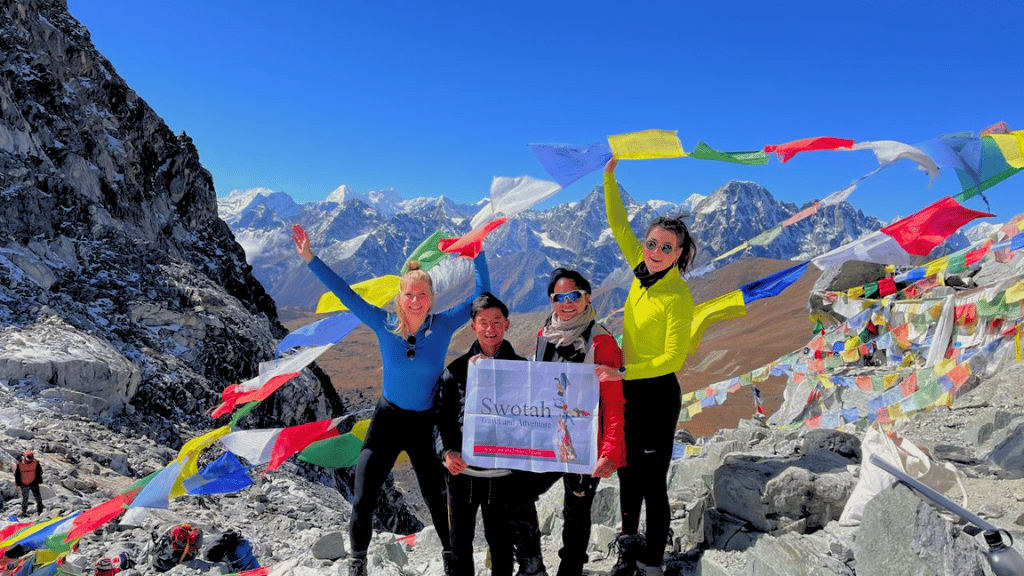
Day by day through the Khumbu valley
Twelve days take you from Lukla to Base Camp and back to Kathmandu, with arrival, departure and a spare day around them. Here's the schedule our groups follow.
| Day | Route | Altitude | Notes |
|---|---|---|---|
| 1 | Fly Kathmandu to Lukla, trek to Phakding | 2,610m | 3-4 hrs walking; gentle descent through pine forest |
| 2 | Phakding to Namche Bazaar | 3,440m | 5-6 hrs; steep climb, first big altitude gain |
| 3 | Acclimatisation in Namche | 3,440m | Day hike to Everest View Hotel (3,880m), sleep at Namche |
| 4 | Namche to Tengboche | 3,867m | 5 hrs; continuous Everest and Ama Dablam views |
| 5 | Tengboche to Dingboche | 4,410m | 5 hrs; forest ends, valley opens into tundra |
| 6 | Acclimatisation in Dingboche | 4,410m | Day hike to Nagardanda (5,083m), sleep at Dingboche |
| 7 | Dingboche to Lobuche | 4,910m | 4 hrs; along the Khumbu Glacier's lateral moraine |
| 8 | Lobuche to Everest Base Camp, sleep at Gorak Shep | 5,364m / 5,164m | 7 hrs; the day you reach Base Camp itself |
| 9 | Kala Patthar sunrise, descend to Pheriche | 5,545m / 4,280m | 7 hrs; pre-dawn climb, then a long descent |
| 10 | Pheriche to Namche Bazaar | 3,440m | 7 hrs; retracing the route downhill |
| 11 | Namche to Lukla | 2,860m | 7 hrs; final trekking day |
| 12 | Fly Lukla to Kathmandu | 1,400m | Weather-dependent; buffer day recommended |
The Dudh Koshi and the Khumbu Glacier shape this route more than any single day. The trail crosses and recrosses the Dudh Koshi on high suspension bridges hung with prayer flags, then follows the glacier's lateral moraine from Lobuche. By day 8 the forest and fields are long gone. Rock, ice and wind.
Altitude and acclimatisation: why Namche and Dingboche matter
Two rest days decide most people's trek. Namche Bazaar (3,440 metres) on day 3, and Dingboche (4,410 metres) on day 6. On both you climb several hundred metres during the day and come back down to sleep, the climb-high, sleep-low principle. It works. Skipping either day is one of the commonest reasons people turn back on this route.
Acute mountain sickness is the main medical risk above Namche. Our guides check every trekker's oxygen saturation twice a day from Namche onward and set a slow pace, which is the best protection there is. Read an altitude sickness prevention guide before you go. The early signs look like ordinary trekking tiredness until they aren't, so treat a headache that won't go, a vanished appetite or a run of broken nights as a warning and tell your guide the same evening.
High altitude cerebral oedema and high altitude pulmonary oedema are rarer and can kill, and both mean going down straight away. Guides on this route carry emergency oxygen and pulse oximeters above 4,000 metres. A helicopter evacuation from anywhere in the Khumbu typically costs USD 4,500 to 6,500, so check your insurance covers it before you fly to Lukla.
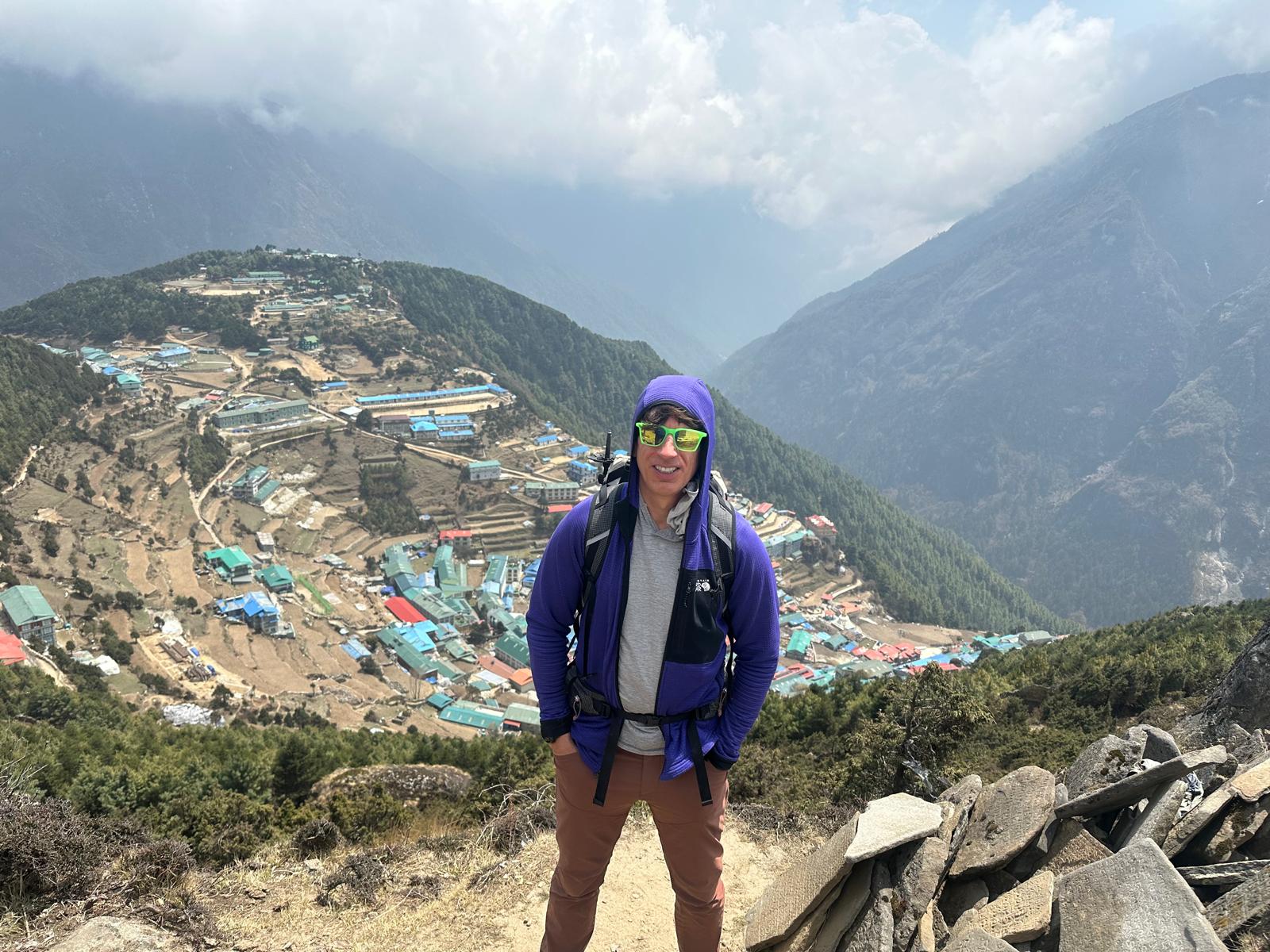
What Everest Base Camp looks like
Base Camp is a stretch of grey moraine on the Khumbu Glacier. There's no summit view from the boulder where everyone takes their photo at 5,364 metres, because Nuptse's west ridge is in the way. What you do see is the Khumbu Icefall, a jumble of ice towers and crevasses right above camp that expedition climbers must cross every spring, creeping downhill by up to about a metre a day. In April and May the moraine fills with hundreds of expedition tents. The rest of the year it's nearly empty apart from prayer flags, cairns and memorials to climbers who didn't come home.
The famous Everest photo comes from Kala Patthar (5,545 metres), a rocky hill above Gorak Shep, about 180 metres higher than Base Camp. You climb it before dawn on day 9 to be on top for sunrise. From there the summit pyramid and the upper south-west face rise above Nuptse's wall, with Lhotse to the right. Base Camp alone would feel like an anticlimax for many people, which is why the Kala Patthar climb is in the plan.


Permits for the Everest Base Camp trek in 2026
Two permits cover every trekker on this route. The Sagarmatha National Park permit costs NPR 3,000 plus 13 percent VAT, so NPR 3,390 (about USD 25), paid at the Tourist Service Centre in Kathmandu or at the Monjo checkpoint. The Khumbu Pasang Lhamu Rural Municipality permit replaced the TIMS card here in 2018 and is issued at Lukla or Monjo. Its fee went up. Foreigners now pay NPR 3,000 (about USD 22), SAARC nationals NPR 2,000. Some counters and agencies still quote the old NPR 2,000 rate, so confirm with your operator before you budget.
| Permit | Issued at | Cost |
|---|---|---|
| Sagarmatha National Park entry | Kathmandu Tourist Service Centre or Monjo | NPR 3,390 (~USD 25, incl. VAT) |
| Khumbu Pasang Lhamu Rural Municipality | Lukla or Monjo | NPR 3,000 (~USD 22) for foreigners |
Since April 2023 Nepal has required trekkers in its national parks, Sagarmatha included, to walk with a licensed guide. A guide costs USD 25 to 35 a day if you hire one directly, or comes inside any guided package.
What the Everest Base Camp trek costs in 2026
A guided 14-day trip from a Nepali operator costs USD 1,200 to 1,800 per person in 2026, depending on group size, season and whether you fly from Manthali. Our prices by group size are below.
| Group size | Price per person |
|---|---|
| Solo private | USD 1,890 |
| Couple / small private (2-3) | USD 1,490 |
| Standard group (4-7) | USD 1,390 |
| Large group (8-12) | USD 1,350 |
That covers permits, a TAAN-certified guide, a porter, all teahouse meals and beds, and both Lukla flights, which alone cost USD 430 to 510 return at 2026 fares. Going independent saves less than it used to, because the guide is now a fixed cost either way. To trim the budget, carry your own daypack, skip hot showers and charging above Namche, where both are expensive, and travel in late March, November or December, when our departures cost less than in mid-October. A helicopter back from Gorak Shep, which saves three days of walking down, costs USD 750 per person. The Everest Base Camp cost guide has the details.
Difficulty, fitness, and who this trek suits
We rate it strenuous. Not extreme. Expect five to seven hours a day on uneven trail, suspension bridges and moraine, with a night at Gorak Shep at 5,164 metres. You need no technical skill at all, no ropes, no crampons, no glacier travel beyond a well-worn moraine path. It needs steady aerobic fitness. And patience. Pace, more than strength, separates those who reach Kala Patthar from those who turn back at Dingboche.
Train first. Ten to twelve weeks built around weekend hikes with a loaded daypack gets most reasonably fit adults ready. Age matters less than people think. Our groups include trekkers from their teens to their sixties, though anyone with a heart or lung condition should get a doctor's clearance first. Our Everest Base Camp difficulty guide goes into more depth.
Best time to trek to Everest Base Camp
October and November give the clearest views of the year. High pressure settles over the Khumbu after the monsoon, and daytime temperatures at Base Camp sit around 7°C. April and May come close. Warmer, busier with expedition traffic, and a little cloudier in the afternoons. Crowds, though. Namche and Dingboche lodges can fill if you haven't booked.
March and early December are quieter. Nights are colder, down to minus 10°C or lower at Dingboche, but the trail is far less busy. June to August brings the least reliable weather, frequent Lukla delays and hidden mountains. We run a July departure at USD 1,190 for people happy to gamble on the weather, though we'd steer most first-timers toward spring or autumn.
Choosing between EBC, Three Passes, and Annapurna
People usually weigh EBC against two other routes. Against Three Passes, EBC is shorter and less technical, 12 walking days against 16 to 18, with no glacier crossing on Cho La and no boulder scramble on Kongma La. Against Annapurna Base Camp it's the other way round. EBC goes about 1,400 metres higher, costs more and needs the Lukla flight. Our Annapurna vs Everest Base Camp comparison sets out the trade-offs by altitude, cost and crowds.
For most first-time high-altitude trekkers with two weeks or a little more, the classic EBC route is the right call. Kala Patthar's view, the Sherpa culture of Namche and Tengboche, and a real altitude challenge, without the extra technical demands of the passes. If it goes well, Three Passes or Gokyo will still be there next season.
Frequently asked questions
How many days is the Everest Base Camp trek?
Our standard trip is 14 days, with 12 days of walking to Kala Patthar (5,545 metres) and back. That includes acclimatisation days at Namche and Dingboche.
How much does the Everest Base Camp trek cost?
Our guided trek starts at USD 1,350 per person, including both Lukla flights, permits, a guide and a porter. Fixed departures range from USD 1,190 in July to USD 1,690 in peak October.
Do you need a guide for Everest Base Camp?
Yes. Base Camp lies inside Sagarmatha National Park, where a licensed guide has been required since the 1 April 2023 rule. Our packages include a TAAN-certified Sherpa guide.
Related guides
- The Everest Base Camp trek cost
- How hard the Everest Base Camp trek is
- The Kathmandu to Lukla flight
More on the mountains

Founder & Lead Guide, Annapurna Trekking
AJ founded Annapurna Trekking in 2016 and has personally guided treks across Nepal ever since. More about our team →
Ready to walk it?