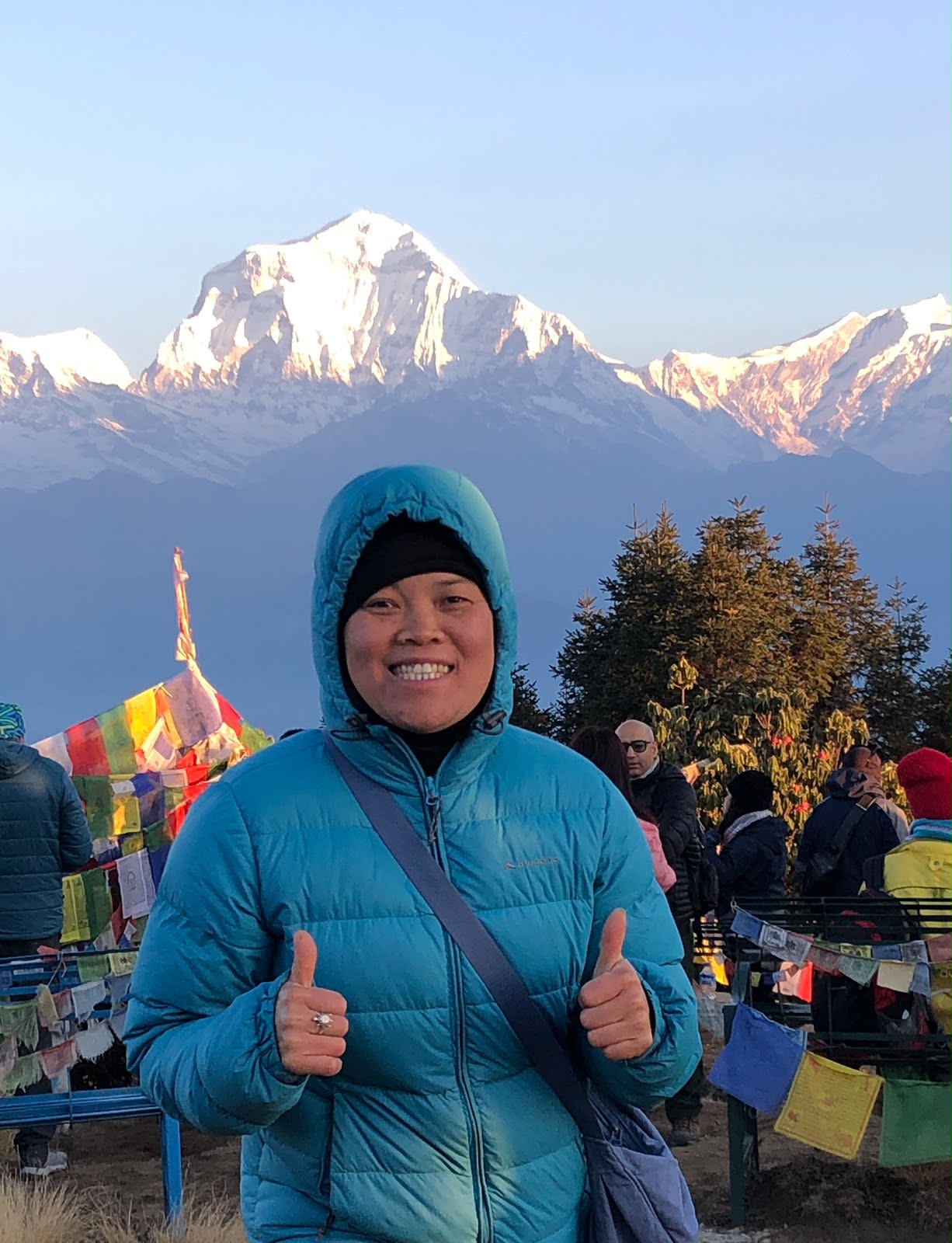
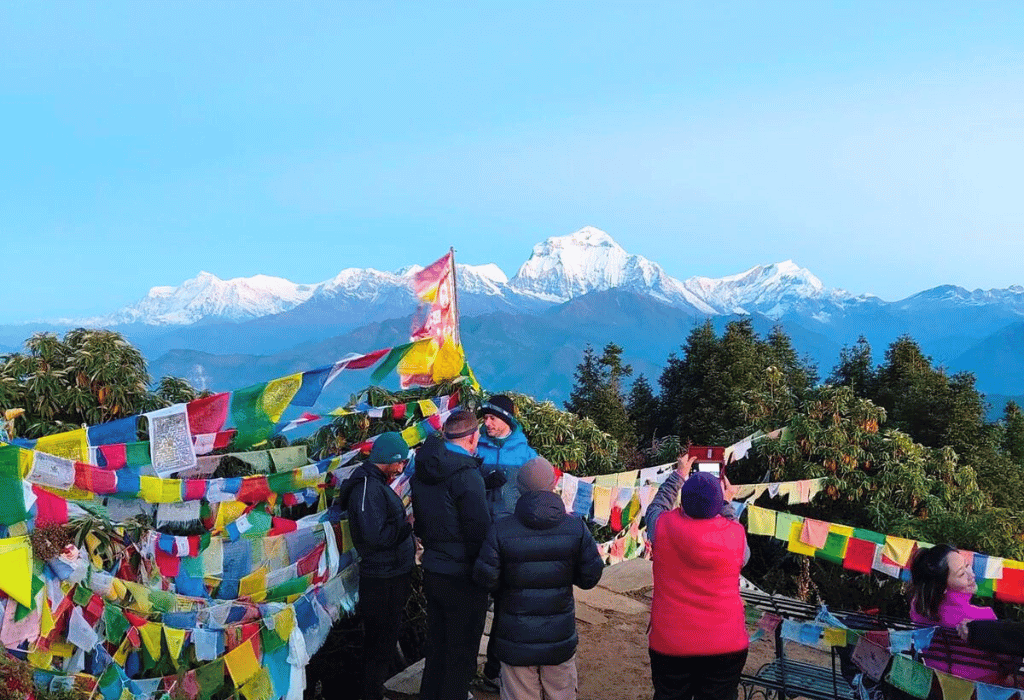
Poon Hill is a 3,210-metre viewpoint above the village of Ghorepani, reached by a short climb in the dark. At first light you see Dhaulagiri (8,167 metres), Annapurna I (8,091 metres), Annapurna South, Hiunchuli and the fishtail of Machhapuchhre from one spot, about as wide a Himalayan panorama as any trek this short can offer. The walking takes four days from Pokhara, and our package is five with an arrival day. That makes it Nepal's easiest multi-day Himalayan trek and a favourite with first-timers, families and anyone short on holiday.
What does the 4-day itinerary look like?
You drive from Pokhara to Nayapul, about 90 minutes, and walk up the Bhurungdi and Ghorepani valleys to the ridge. The sunrise climb happens on the third morning.
| Day | Route | Altitude |
|---|---|---|
| 1 | Drive to Nayapul, trek to Tikhedhunga | 1,540m |
| 2 | Tikhedhunga to Ghorepani | 2,874m |
| 3 | Poon Hill sunrise, trek to Tadapani | 3,210m to 2,630m |
| 4 | Descend to Nayapul, drive to Pokhara | 820m |
Day 2 is the hard one. Above Tikhedhunga, about 3,300 stone steps climb roughly 500 metres to the Magar village of Ulleri, and the trail keeps rising through rhododendron forest to Ghorepani after that. The trek is graded easy overall, and that staircase still has people stopping every twenty steps. Day 4 drops gently through Ghandruk's terraces and oak forest. All the effort comes early.

What makes the sunrise worth the 5am wake-up?
You leave Ghorepani around 5 a.m. by head-torch, and the climb takes about 45 minutes. Then you wait. The peaks catch the sun well before the valleys do, and over roughly twenty minutes Dhaulagiri and Annapurna South turn pink, then gold, then white. It's one of the most photographed sunrises in Nepal, and in October and April the viewing platform shows it.
Where did Poon Hill get its name, and why this particular spot?
The hill is named after the Pun, a Magar clan whose families still live in the villages along the route. Plenty of nearby ridges are about as high. Poon Hill wins on angle. It looks straight across the Kali Gandaki gorge to Dhaulagiri and up at the Annapurnas with nothing in between, a sightline you'd usually need a much longer approach to get.
When is the best time to go?
In March and April the forest between Tikhedhunga and Ghorepani turns red and pink with rhododendrons, Nepal's national flower, for several weeks. October and November bring the clearest views and the steadiest weather, along with the biggest crowds on the platform. Both work. It comes down to flowers or the best chance of a clear horizon.
| Season | Conditions |
|---|---|
| Mar-Apr | Rhododendron bloom, warm days, medium-to-high crowds |
| Oct-Nov | Clearest views, cool nights, highest crowds |
| Jun-Aug | Monsoon rain, low crowds, poor visibility odds |
| Dec-Feb | Cold, low crowds, generally still walkable given low max altitude |
What should you pack for a trek this short?
Less than a long trek, but take the dawn seriously. On top before sunrise it's often at or below 0°C, even when the afternoons are warm enough for a T-shirt, so carry a warm hat, gloves, a down or synthetic jacket and a head-torch that morning. Boots you've already broken in. A rain shell too. Afternoon showers happen even outside the monsoon, and a porter carries the main bag between teahouses, so a daypack is all you need on your back.
What permits and fitness level does it require?
You need the same two permits as anywhere in the Annapurna region. ACAP costs NPR 3,000 (about USD 23) and the TIMS card NPR 2,000 (about USD 15). The top is only 3,210 metres and you sleep no higher than 2,874, so altitude sickness is rarely a concern. That's why the trek is graded easy and suits beginners. The real physical test is the staircase to Ulleri.
Our guided package starts at USD 390 per person and includes a TAAN-certified guide, a porter, permits, teahouse rooms and all meals. See the Poon Hill Trek page for 2026 and 2027 dates, or read our Annapurna Circuit vs Base Camp comparison if you're weighing a short taster against a longer trek.

How does Poon Hill compare to a longer Annapurna trek?
Poon Hill gives you the full panorama in four walking days for USD 390. Annapurna Base Camp takes you inside the Sanctuary, walking among the peaks for 11 to 13 days from USD 890. One is a view of the mountains from a ridge, the other is a week spent among them. Poon Hill fits a short holiday or a gentle first try. ABC suits people who want days on end among 7,000 and 8,000-metre peaks, and our 11-day ABC route starts with Poon Hill anyway.
Common questions about the Poon Hill trek
Is Poon Hill suitable for children or older trekkers?
Yes, more than almost any other Himalayan trek in Nepal. The low top altitude and short length keep the altitude risk small, and the trail is well kept and needs no technical skill. What matters is fitness for the one steep staircase, not age.
Can Poon Hill be combined with a longer trek?
Easily. Our 11-day Annapurna Base Camp trek opens with the same Tikhedhunga, Ghorepani and Tadapani days, and our 14-day Annapurna Circuit finishes over Poon Hill after crossing Thorong La.
How crowded does the viewpoint get in peak season?
Very. In October and April there can be a hundred or more people on and around the platform at sunrise. The view is unaffected, and leaving Ghorepani ten minutes before everyone else gets you a spot at the front.
What's the accommodation like along this route?
Comfortable, by Himalayan standards. So many trekkers pass through that lodges here are some of the best in the Annapurna region, with decent twin rooms, hot showers for a small fee and menus far longer than on remote routes. Ghorepani has the most choice, since every group sleeps there before the sunrise climb. Tikhedhunga and Tadapani are smaller. Rooms are mostly twin-share with shared bathrooms lower down, and most lodges will give you a room to yourself for a supplement. Charging costs a little per device. Wifi is everywhere, and staying in touch is easy on this one.
Related guides

Founder & Lead Guide, Annapurna Trekking
AJ founded Annapurna Trekking in 2016 and has personally guided treks across Nepal ever since. More about our team →