The Annapurna Circuit and Annapurna Base Camp are the two busiest routes in the Annapurna region, and they feel almost nothing alike. The Circuit is a high loop. It takes 10 to 17 days, 14 as standard, and crosses Thorong La at 5,416 metres. Base Camp is an 11 to 13-day walk in and out of a glacier bowl at 4,130 metres. Below, the two go head to head on time, altitude, scenery, difficulty and 2026 price.
The Circuit goes around the Annapurna massif. It climbs the Marsyangdi valley, crosses the pass, and comes down the Kali Gandaki gorge on the far side. Annapurna Base Camp climbs a single valley, the Modi Khola, and ends inside the Annapurna Sanctuary with peaks from about 6,400 to 8,091 metres standing over you. Both sit inside the Annapurna Conservation Area, both need an ACAP permit, and both are run from Pokhara. That's where the similarity stops.
Quick comparison table
| Factor | Annapurna Circuit | Annapurna Base Camp |
|---|---|---|
| Typical duration | 10 to 17 days (14 standard) | 11 to 13 days |
| Highest point | Thorong La 5,416m | Annapurna Base Camp 4,130m |
| Route shape | One-way loop | Out and back |
| Total distance | 160 to 230km (road-dependent) | about 70 to 115km |
| Difficulty | Strenuous (high pass) | Moderate |
| Altitude-sickness risk | High at the pass | Moderate |
| Best months | Mar to May, Sep to Nov | Mar to May, Sep to Nov |
| Package price (from) | USD 1,190 | USD 890 |
| Scenery | Changing: green hills to high desert | Glacial amphitheatre, close peaks |
Duration and route shape
The Circuit is long because it goes all the way round. It climbs slowly from about 760 metres at Besisahar to 5,416 metres at Thorong La, then drops to Muktinath and Jomsom. No day repeats another. Roads now run up both valleys, so most people, us included, drive the first and last sections and walk the high middle. Our 14-day standard trip fits into about two and a half weeks with flights. The Annapurna Circuit itinerary shows where the jeeps come in.
Base Camp is quicker to fit into a holiday. It climbs the Modi Khola and comes back the same way. Our 11-day version reaches the Sanctuary on day 8 after a Poon Hill sunrise on day 4, then takes two easy days down past the Jhinu hot springs to Pokhara. Short on time? Skip Poon Hill and you can stand at base camp on day 4 of a 7-day trip. Both versions are mapped in the Annapurna Base Camp itinerary.
Altitude and difficulty
Thorong La makes the Circuit strenuous. You leave Thorong Phedi or High Camp in the dark, climb for hours at minus 10°C or colder, then lose 1,600 metres down to Muktinath on loose ground. Above 4,000 metres acute mountain sickness is a real risk, and the rest day at Manang (3,540 metres) is the main defence, as our altitude sickness prevention guide explains. The Circuit's difficulty rating comes from the pass, the cold and the distance.
Base Camp stops at 4,130 metres, almost 1,300 metres lower. Altitude sickness is less likely there, though it still happens. The staircases around Chhomrong are steep, but there's no pass and no exposed ridge. After heavy snow the bigger danger is avalanche on the final stretch past Hinku Cave and Deurali, and guides watch that section closely. For a reasonably fit walker, ABC is a moderate trek with no high-altitude experience needed.
Scenery and culture
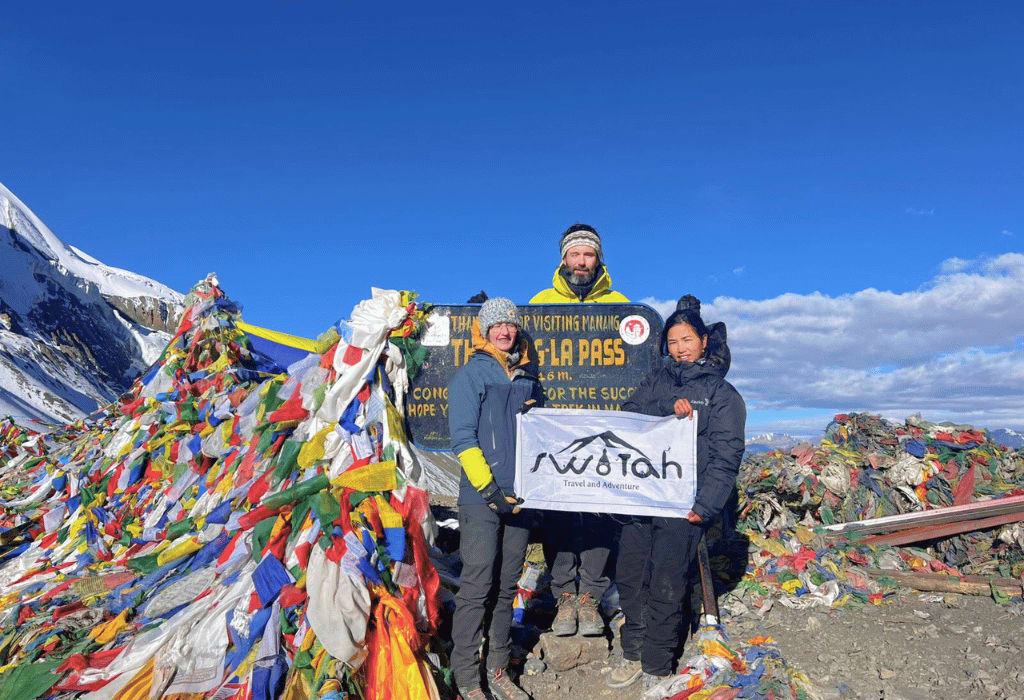
Change is the whole point of the Circuit. You start among rice terraces near Besisahar and climb through pine and rhododendron to the Buddhist villages of Manang and Braga. Above them the ground turns to high desert below Thorong La, and on the far side sits Muktinath, a temple complex sacred to Hindus and Buddhists alike. Then comes the Tibetan-looking Kali Gandaki. Few treks anywhere pack in this much scenery, climate and culture.

Base Camp swaps variety for drama. One deep valley narrows as you climb, then opens all at once into the Sanctuary. Annapurna I (8,091 metres), Machhapuchhre (6,993 metres), Hiunchuli and Gangapurna close almost a full circle of ice and rock around you. Sunrise on Annapurna's south face from base camp is one of the most photographed views in Nepal. The culture is mostly Gurung, in villages like Ghandruk and Chhomrong on the lower slopes.

Cost comparison for 2026
Our Circuit packages start at USD 1,190 per person. The extra comes from more nights, more teahouse meals and the transport needed for a one-way route that ends in Jomsom or Pokhara. Arranging it yourself, budget USD 30 to 45 a day on the trail plus ACAP at NPR 3,000 and TIMS at NPR 2,000, although checkpoints on the Circuit mostly look at the ACAP stamp and your guide's licence and wave the TIMS card through. Either way, a licensed guide has been compulsory in conservation areas since April 2023. The Annapurna Circuit cost breakdown has the detail.
Base Camp packages start at USD 890, thanks to the shorter trip and simpler logistics in one valley. You need the same permits and a guide, and daily spending sits in the same USD 30 to 45 range. Being three or so days shorter, ABC is cheaper overall once flights and rest days are counted. The Annapurna Base Camp cost guide compares package and independent figures.
Best time to walk each trek
Both treks peak in the same windows, March to May and September to November. Autumn has the steadiest weather and the clearest views. Spring brings rhododendrons to the lower forests. Thorong La can hold snow into early spring and sometimes shuts after winter storms, so timing matters more on the Circuit than in the Sanctuary, as our best time to trek Annapurna Circuit guide sets out.
Base Camp works across more of the year because it's lower. Winter snow does raise the avalanche risk near the top, and the monsoon brings leeches and cloud lower down. If you're a first-timer worried about weather and acclimatisation, go to ABC in October or April.
Accommodation and food on each route
Teahouses on both treks work the same way, with private or twin rooms and shared bathrooms lower down and simpler, colder rooms near the high points. On the Circuit, Manang and Muktinath have long-established lodges with bakeries, heated dining rooms and big menus, thanks to decades of trekkers. Above Thorong Phedi the choice shrinks fast, and the night before the pass is the least comfortable of the trip.
On the Base Camp route the best lodges are in the Gurung villages of Ghandruk and Chhomrong. Rooms get plainer toward Deurali and the Sanctuary. The route is short and busy, so menus stay long, with dal bhat, pasta, momos and soup at nearly every stop, and prices rise with altitude just as on the Circuit. Free dal bhat refills apply on both routes, and they're the best-value meal anywhere in the region.
Fitness and training
The Circuit asks for more. Several days run past six hours, and pass day pairs a steep pre-dawn climb with a 1,600-metre descent. Two or three months of hill walking, stair climbing and back-to-back long days before you fly will decide whether you enjoy the loop or just grind through it. Train with a light daypack, since that's what you'll carry on the trail.
For Base Camp, leg strength counts for more than endurance. Days are shorter and the top is 1,300 metres lower than Thorong La. The hardest physical feature is the stone staircases around Chhomrong, thousands of steps in places. Six weeks of training gets most active people round comfortably, which is part of why ABC suits a first Himalayan trek.
Who each trek suits
Pick the Circuit if you have two weeks or more, want the widest range of landscapes, and see a 5,416-metre pass as part of the attraction. Pick Base Camp if you have 11 to 13 days, want a moderate trek with a huge finale, prefer to stay below 4,200 metres, or this is your first Himalayan walk. Our standard ABC route already includes Poon Hill, so you get the sunrise panorama and the Sanctuary in one trip. And if you can only travel in the monsoon, the Circuit's upper half around Manang and Mustang sits in a rain shadow and stays fairly dry while the rest of Nepal is soaked.
Our recommendation
For a first trip with under two weeks free, the Annapurna Base Camp trek gives the most reward for the effort, ending in one of the great mountain amphitheatres on earth with no high pass. With more time, more fitness and an appetite for a bigger goal, the Annapurna Circuit trek and its Thorong La crossing remain the classic. Send us your dates and fitness and we'll suggest a route. WhatsApp us on +977 984 159 5962 or use our contact page to plan a 2026 or 2027 departure.
Frequently asked questions
Which is harder, the Annapurna Circuit or Base Camp?
The Circuit. It reaches 5,416 metres at Thorong La and usually takes 14 days. Base Camp tops out at 4,130 metres over 11 to 13 days and is rated moderate.
Which is better for first-time trekkers?
Base Camp, for most people. It's shorter, lower and cheaper, from USD 890, and it ends in a glacier sanctuary that few views anywhere can match. The Circuit is a bigger commitment.
What is the cost difference?
Base Camp packages start at USD 890 and Circuit packages at USD 1,190, a USD 300 gap that mostly reflects the Circuit's extra days.
Related guides

Founder & Lead Guide, Annapurna Trekking
AJ founded Annapurna Trekking in 2016 and has personally guided treks across Nepal ever since. More about our team →