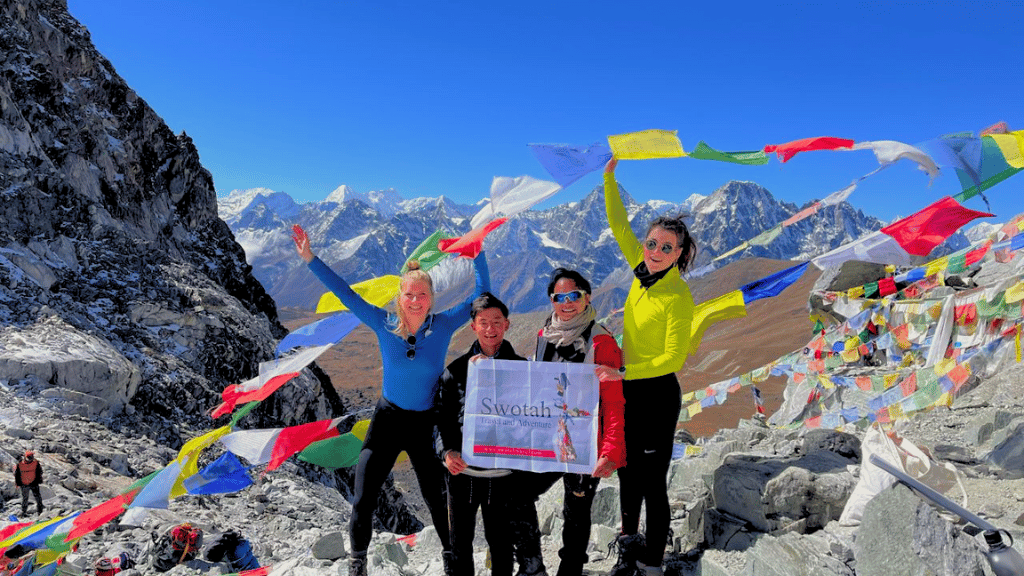
Everest Three Passes Trek
The Everest Three Passes Trek is the most complete circuit available in the Khumbu region. It crosses three Himalayan passes above 5,360 metres, Renjo La (5,360 m), Cho La (5,420 m), and Kongma La (5,535 m), and visits Everest Base Camp (5,364 m), Kala Patthar (5,555 m), and the Gokyo Valley in a single 18-day loop. No other trek in the Everest region covers this much terrain at this altitude.
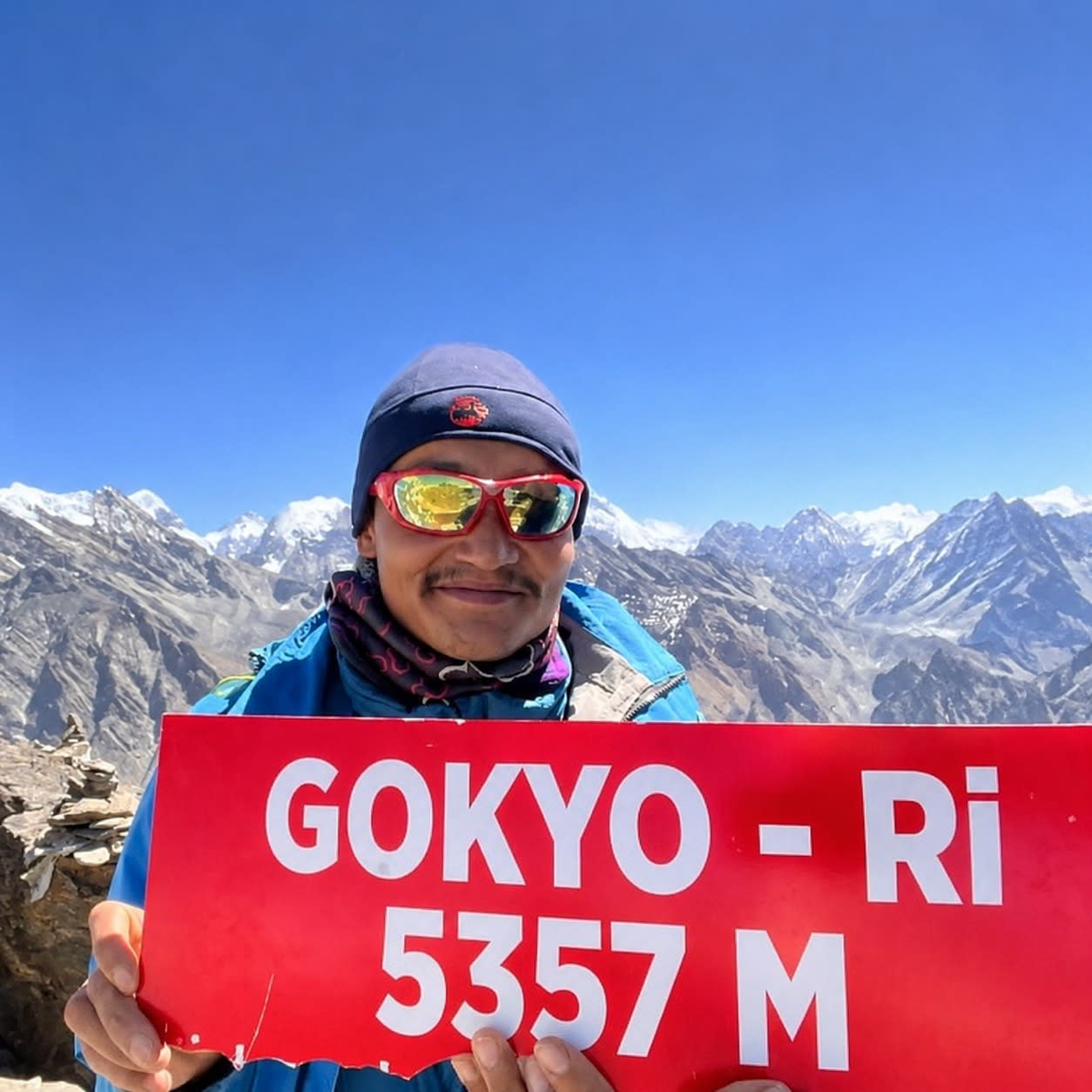
The route leaves Namche Bazaar northward toward Thame, a village that has produced some of the most accomplished Sherpa climbers in history. From Thame the trail climbs to Lungden (4,380 m) and crosses Renjo La on Day 7, dropping into the Gokyo Valley. The Gokyo Lakes are a sequence of six glacial lakes at 4,700 to 5,000 metres, each a different shade of turquoise depending on time of day and cloud cover. The third and fourth lakes are the most photographed. Gokyo Ri (5,357 m), climbed before dawn from the Gokyo teahouses, delivers what many experienced Himalayan trekkers consider the best single view in Nepal, Everest, Lhotse, Makalu, and Cho Oyu appearing simultaneously above the Ngozumpa Glacier.
Cho La (5,420 m) is crossed from Thangnak on Day 10. This is the most technically demanding of the three passes. The eastern approach involves a short section of glaciated terrain with fixed rope assistance. Under normal autumn or spring conditions no specialised climbing equipment is required, but the guide assesses the pass each morning and will hold back or reroute if conditions are unsafe. The descent from Cho La into the Khumbu Valley is steep and rocky, and the crossing takes 7 to 8 hours in total.
Everest Base Camp lies at 5,364 metres on the Khumbu Glacier moraine below Khumbutse. During the climbing season (April, May, October) the base camp is an active expedition hub with hundreds of tents, teams, and communication towers. In other months it is a rocky, wind-scoured plateau with a cairn and the sound of the glacier creaking. Kala Patthar (5,555 m) above Gorak Shep is climbed before dawn on Day 13 and delivers the closest and most direct view of Everest's southwest face from a trekking trail anywhere.
Kongma La (5,535 m), the highest of the three passes, is crossed on Day 14. The ascent from Lobuche is on a well-marked rocky trail with some exposure near the summit. The descent into Chukhung valley is long and knee-testing. Chukhung Ri (5,546 m) is an optional additional summit above the Chukhung village that adds another 4 to 5 hours and a north-facing view of Lhotse's south wall.
This trek is not for first-time Himalayan visitors. You should have previous trekking experience to at least 4,500 metres before attempting this route. The physical demands across 16 trekking days at very high altitude require sustained cardiovascular fitness, good nutrition, and reliable acclimatisation. Our guide monitors oxygen saturation each evening and is authorised to descend any trekker immediately if medical markers indicate risk. Helicopter evacuation from the Khumbu region is efficient, most evacuation flights reach Kathmandu within 45 minutes, but your insurance must cover it.
The best months are October, November, March, and April. October gives the most stable weather, clearest skies, and the best chance of a cloudless sunrise from Kala Patthar.
Upcoming departures.
| Start Date | End Date | Price / Person | Availability | |
|---|---|---|---|---|
| Nov 1, 2026 | Nov 18, 2026 | USD 1,850 | 7 spots left | |
| Apr 4, 2027 | Apr 21, 2027 | USD 1,920 | 8 spots left | |
| Oct 3, 2027 | Oct 20, 2027 | USD 2,050 | 8 spots left |
7 moments you won't forget.
Three passes above 5,360 metres
Renjo La (5,360 m), Cho La (5,420 m), and Kongma La (5,535 m) are crossed on days 7, 10, and 14 respectively. Each pass offers a distinct character. Renjo La is a long ridge walk with a gradual approach from Lungden. Cho La is the most technical, with a glaciated section on the eastern approach that requires care in any season and crampons in winter. Kongma La is the highest and the longest day, but on a well-marked rocky trail with no glaciated terrain. Crossing all three in a single circuit is what distinguishes this route from any other trek in Nepal.
Gokyo Ri and the four 8,000 m peaks
Gokyo Ri (5,357 m) rises directly above the Gokyo teahouses and is climbed in 2 to 3 hours from the village. At the summit four peaks above 8,000 metres appear in the same northward view: Everest (8,848 m), Lhotse (8,516 m), Makalu (8,485 m), and Cho Oyu (8,201 m). The Ngozumpa Glacier, Nepal's longest at 36 kilometres, fills the foreground. Many experienced Himalayan trekkers rate this as a better view of Everest than Kala Patthar because the mountain appears in full context with its surrounding massif rather than as a close-up behind the Khumbu Icefall.
The Gokyo Lakes at 4,700–5,000 m
Six glacial lakes sit in the Gokyo Valley at altitudes between 4,700 and 5,000 metres. The first lake (Longponga Tsho) is the largest. The third (Dudh Pokhari) is the most visited and turquoise at dawn. The sixth lake at 5,000 metres requires a separate half-day hike from the Gokyo teahouses and is rarely crowded. All six are protected as a Ramsar Wetland Site, one of the world's highest designated wetlands, under a 2007 designation. The lakes are most vividly coloured in the early morning hours before cloud builds from the valleys.
Cho La glacier crossing at 5,420 m
The Cho La approach from Thangnak follows a moraine and then crosses a short glaciated section with fixed ropes. The fixed ropes assist with the steepest 50 to 80 metres of the ascent. Under normal conditions in October and November, trekking boots with good grip are sufficient. In spring (March–April), early snow from the winter may still cover the upper section and crampons may be needed. Our guides carry one pair of spare crampons per group for the Cho La day. The descent into Dzongla is steep rocky terrain, poles are essential here.
Everest Base Camp and Kala Patthar
EBC at 5,364 metres is a broad moraine beside the Khumbu Glacier at the foot of the Khumbu Icefall. During climbing season (April–May, October) the camp is occupied by expedition teams with hundreds of tents. In November and March the site is almost empty. The Khumbu Icefall is visible from the camp but the summit of Everest is not, Nuptse obscures it. Kala Patthar (5,555 m) above Gorak Shep provides the closest direct view of Everest's southwest face from any trail in Nepal. The pre-dawn climb from Gorak Shep takes 1.5 to 2 hours and the summit temperature in October is typically -10 to -15°C.
Thame: the Sherpa climbing village
Thame village (3,800 m) sits 10 kilometres west of Namche Bazaar and has produced more Everest summiteers per capita than any other village on earth. Tenzing Norgay, who made the first ascent of Everest with Edmund Hillary on 29 May 1953, was born in this area. The village monastery, Thame Gompa, dates to the 18th century and holds annual festivals attended by the entire Khumbu Sherpa community. The trail through Thame on Day 5 is one of the quieter sections of the circuit, far from the crowded Namche–Tengboche corridor.
Kongma La: the highest pass at 5,535 m
Kongma La is the last of the three passes and the highest. The crossing on Day 14 begins at Lobuche (4,940 m) and ascends a long rocky ridge to the pass before descending steeply into the Chukhung Valley. The day covers approximately 12 kilometres and takes 7 to 8 hours. The pass is marked with a cairn and prayer flags at 5,535 metres. On a clear day the view from the pass summit takes in Makalu, Baruntse (7,129 m), Ama Dablam (6,812 m), and the Lhotse south wall. The descent to Chukhung is long and the terrain is loose and rocky, trekking poles and careful footing are both required.
Interactive circuit map.
The full 18-day circuit on a topographic map. Click any marker for details. Switch between Topo, Satellite, and Standard views using the layer control.
18 days. Every detail planned.
Transparent, all-in pricing.
Included in your price
Not included
Trek altitude at a glance.
How hard is this trek?
Best time for the Everest Three Passes Trek.
Weather on the Everest Three Passes Trek.
Everything you need to know.
Open any card for in-depth notes on accommodation, food, altitude, permits, money and the small print that matters on the trail.
Your safety, planned in detail.
Altitude is the main risk on this trek. Here is exactly what we carry, who we call, and where the nearest help is at every stage of the route.
Common health risks
- •AMS/HAPE/HACE, significantly higher than EBC due to cumulative altitude exposure (5+ nights above 4,700m)
- •Frostbite on pass crossings
- •Snow blindness from glacier sections (Cho La)
- •Crampons-related ankle injury (Cho La in icy conditions)
- •Hypothermia at high camps without heating
- •Dehydration: cumulative effect over 18 days
- •Knee/joint stress from cumulative distance and elevation
- •Lukla flight cancellation extending the trip by days
Our medical kit
- •Pulse oximeter (carried by guide, checks oxygen saturation)
- •Emergency oxygen cylinder (lead guide carries one above 4,000m)
- •Diamox (acetazolamide) for acute mountain sickness
- •Dexamethasone (HACE emergency use)
- •Nifedipine (HAPE emergency use)
- •Broad-spectrum antibiotics
- •Anti-diarrhoeal medication
- •Antihistamines
- •Strong painkillers (ibuprofen + paracetamol)
- •Wound dressings, blister kit, bandages
- + 6 more items carried by the lead guide
Travel insurance — required
- ✓Must cover trekking up to 5,600m (Kala Patthar + three passes all above 5,300m)
- ✓Must include helicopter evacuation (USD 5,000+ coverage minimum)
- ✓Must include medical and emergency repatriation
- ✓We recommend World Nomads, True Traveller (UK), or Safety Wing, all cover Nepal trekking at altitude
- ✓Bring policy printout + emergency phone number to the pre-trek briefing
Nearest medical facilities
- •Pheriche: HRA clinic (Western volunteer doctors Sep–Nov, Apr–May)
- •Namche: Khunde Hospital
- •Lukla: Pasang Lhamu Memorial Hospital
- •Kathmandu: CIWEC Travel Medicine Centre
- •Kathmandu: Norvic International Hospital
Emergency protocols
Three Passes is the most altitude-demanding trek in our portfolio. Oxygen saturation checked twice daily from Namche onward. We have absolute turn-back protocols: if any group member is below 78% oxygen saturation at any high camp, we descend. Helicopter evacuation operationally feasible from any point. We carry supplemental oxygen at all times. Lead guide is certified in high-altitude medicine (ISMM).
Helicopter evacuation
Helicopter evacuation from Three Passes route: USD 5,500–8,000 depending on landing location. Cho La pass and high camps may not be directly accessible. We coordinate landing at nearest helipad (often Lobuche or Pheriche). Response time 60–120 minutes weather permitting.
Nepal visa on arrival
Tourist visa-on-arrival at Kathmandu (Tribhuvan International) airport. USD 30 / 15 days, USD 50 / 30 days, USD 125 / 90 days. Bring 2 passport photos and USD cash. The arrival kiosk takes credit cards but with a 4–5% surcharge. Process takes 15–30 minutes on arrival depending on flight load.
From your front door to the trailhead.
Every leg of the journey, the mode of transport, the time it takes, and what's included. The complete picture from international arrival to trek start and back again.
Kathmandu → Lukla
IncludedIncluded
Lukla → Kathmandu
IncludedIncluded; build 2 buffer days for weather
What to pack.
Plan Your Trek
Planning guides for the Everest Three Passes Trek
Written by our guides, these cover the permits, altitude, timing, and kit you need before you go.
Common questions.
FitnessHow fit do I need to be for the Everest Three Passes Trek?+
This is one of Nepal's most physically demanding treks. You need strong cardiovascular fitness and previous high-altitude trekking experience to at least 4,500 metres. The minimum benchmark: complete a 10-day trek to 4,500 m without significant AMS before attempting the Three Passes. You should be able to walk 10–14 km daily with a 7–9 kg daypack on consecutive days. The hardest days — Cho La, EBC, and Kongma La — each involve 7 to 8 hours of trekking above 5,000 m. Training should include 3 months of sustained cardiovascular exercise (running, cycling, or hill walking) 5 days per week.
FitnessIs prior high-altitude experience required?+
Yes. We require that all trekkers on the Three Passes have previous trekking experience to at least 4,500 metres. The standard EBC trek (14–16 days) is the ideal preparation. If you have not trekked above 4,500 m before, we strongly recommend completing an EBC trek first and attempting the Three Passes in a subsequent season. This is not a conservative policy — the three passes cross terrain above 5,350 m that requires a body already adapted to very high altitude conditions.
HealthWhat is the altitude sickness risk on this trek?+
AMS risk is significant and real on the Everest Three Passes Trek. You spend multiple nights above 4,800 m and cross three passes between 5,360 and 5,535 metres. At 5,500 m the air contains approximately 50 percent of the oxygen available at sea level. Our guides check SpO2 every evening above 4,000 m. Any trekker reading below 75 percent or showing two or more AMS symptoms (persistent headache, nausea, vomiting, loss of coordination) is descended immediately. We carry two emergency oxygen cylinders and maintain contact with helicopter evacuation services throughout. Diamox is strongly recommended — consult your doctor before departure.
HealthWhat is the Cho La pass actually like and how technical is it?+
Cho La (5,420 m) is the most technically demanding section of the trek. The eastern approach from Thangnak involves crossing the lower Ngozumpa Glacier moraine and then ascending a short glaciated section of 50–80 metres with fixed ropes. In autumn (October–November) under normal conditions, good trekking boots and microspikes are usually sufficient. In spring, fresh winter snow may require crampons. The guide assesses the pass via radio contact with ahead parties at 05:00 on crossing day. If conditions are unsafe, we hold at Thangnak for 24 hours. The descent on the western side is steep loose rock — trekking poles are essential.
PlanningWhat is the best time of year for the Everest Three Passes Trek?+
October is the best single month — the clearest skies of the year, best pass conditions, and most reliable views from Gokyo Ri and Kala Patthar. November is nearly as good and less crowded, but temperatures at Gorak Shep drop to -20°C at night in late November. March and April are the spring options — good views but spring snow on Cho La may require crampons. Avoid June through September (monsoon) and December through February (winter extremes and unsafe pass conditions).
PlanningHow do I get to Lukla and what happens if the flight is cancelled?+
We book your Kathmandu to Lukla domestic flights (included in the package). The flight takes 35 minutes and departs 06:00–07:00. Lukla flights are weather-dependent — cancellations happen in the shoulder months and during unsettled periods in peak season. Our package includes one buffer day for Lukla weather delays. If the flight is cancelled, we rebook the next available departure and you stay in Lukla or Kathmandu at no extra cost. If delays exceed 3 days, helicopter transfer from Kathmandu to Lukla is available (at your own cost — approximately USD 350–500 per person shared).
PlanningWhat permits do I need?+
Two permits are required: the Sagarmatha National Park Entry Permit (NPR 3,000, approximately USD 22) and the TIMS card (included in group TIMS when trekking with us). Additionally, the Khumbu Pasang Lhamu Rural Municipality Conservation Fee (NPR 2,000, approximately USD 15) is collected at the Lukla checkpoint. All permits are included in your package price. Bring your passport and two passport-size photos.
PlanningWhat should I budget for personal spending on the trail?+
Budget NPR 40,000–60,000 (USD 300–450) for 18 days of personal spending. Above Namche, costs increase: hot showers run NPR 300–600, Wi-Fi NPR 200–500 per day, soft drinks NPR 200–400, and battery charging NPR 200–400. The Khumbu is expensive because everything is carried in by yak or helicopter. The only ATM is in Namche Bazaar (unreliable in peak season) — withdraw all cash in Kathmandu before departure.
PlanningCan I do the Three Passes Trek without a guide?+
No. Since April 2023, Nepal requires all foreign trekkers to be accompanied by a licensed guide. This applies to all trekking areas including Sagarmatha National Park. The Three Passes Trek also involves glaciated terrain at Cho La that is genuinely hazardous without a guide experienced in the route. Our guides have completed this circuit a minimum of 20 times and make daily pass-condition assessments via radio contact with other guides on the route.
FoodWhat is the food situation at the high camps?+
Food quality decreases with altitude. Namche has excellent teahouses with pizza, pasta, and espresso. Above Namche, the menus simplify to dal bhat, noodles, fried rice, and soups. Above 4,800 m (Lobuche, Gorak Shep), cooking takes much longer because of the altitude — meals may take 45 minutes to 1 hour to arrive. Eat everything you are served even if appetite is reduced — altitude suppresses hunger but your body burns significantly more calories than normal above 5,000 m due to thermoregulation. Carry trail snacks for the pass crossing days where there are no food stops.
SafetyWhat is the turn-back protocol if someone gets sick?+
Any trekker showing a SpO2 reading below 75 percent or two or more AMS symptoms is descended immediately — no exceptions. The guide will accompany the affected trekker down to a safe altitude while an assistant guide (for groups of 3 or more) stays with the rest of the group. Helicopter evacuation from Khumbu landing zones reaches Kathmandu in 40–50 minutes. We maintain 24-hour contact with our Kathmandu office and with helicopter operators. The guide carries two emergency oxygen cylinders. Your travel insurance must cover helicopter evacuation — medical costs for evacuation from Khumbu can reach USD 5,000–8,000.
SafetyIs the Cho La glaciated section safe for non-climbers?+
Yes, under normal autumn and spring conditions with proper footwear and the guide's assistance. The glaciated section is 50–80 metres of ascent on a slope of approximately 30–40 degrees. Fixed ropes installed by local agencies are in place at the start of each season. In October and November, microspikes are usually sufficient for the average trekker. In spring (March–April) or after fresh snowfall, crampons may be needed. Our guides carry one spare set of crampons and assess conditions each morning via radio. If the slope is iced beyond safe trekking conditions, we delay or take the alternative Cho La north route.
InsuranceWhat travel insurance do I need?+
Travel insurance must cover trekking to 6,000 metres and helicopter evacuation. This is a mandatory booking requirement. Standard policies do not cover high-altitude trekking without a specific rider — check your policy carefully before purchasing. The Khumbu evacuation zone covers up to approximately 5,600 m by helicopter. Insurance from World Nomads (Adventure plan), Battleface, or Global Rescue covers the Three Passes Trek. Minimum evacuation coverage: USD 100,000 (helicopter from Khumbu to Kathmandu: USD 4,000–8,000; hospital costs extra). Carry a printed copy and the emergency number on the trail.
Built different. On purpose.
Named lead guide before you book
Every booking is paired with a TAAN Class-A licensed guide who has completed the Three Passes circuit a minimum of 20 times. Name, photo, licence number, and WhatsApp contact shared at confirmation. No swaps.
Private trek, your group only
We do not mix groups on this trek. Your team sets the pace, decides on acclimatisation days, and controls the summit day timing. Groups of 1 to 8 trekkers.
All-in pricing: nothing owed on the trail
Price covers permits (Sagarmatha National Park and TIMS), guide and porter fees, all 50 trek meals, teahouse accommodation throughout, Lukla flights (from Kathmandu and back), and 24-hour evacuation coordination. Personal spending: hot showers, charging, drinks, and tips.
Strict turn-back protocol
SpO2 below 75 percent or two or more AMS symptoms at altitude triggers mandatory descent, no exceptions, no persuasion. Our guides carry an emergency oxygen cylinder and pulse oximeter on all Three Passes departures. We have never had a serious altitude illness on this route.